What happened
On 3 September 2026 the European Research Council (ERC) published the results of its 2026 Starting Grants. Of the 421 grants awarded across Europe, 19 will be carried out at Spanish institutions, according to the count circulated by the news agency EFE based on ERC data.
The number alone says little. It only makes sense once you compare it with previous editions and separate two indicators that are often confused: how many projects Spain hosts as a host country, and how many of the researchers awarded across Europe hold Spanish nationality. These are two different things, and this year they tell different stories.
The numbers
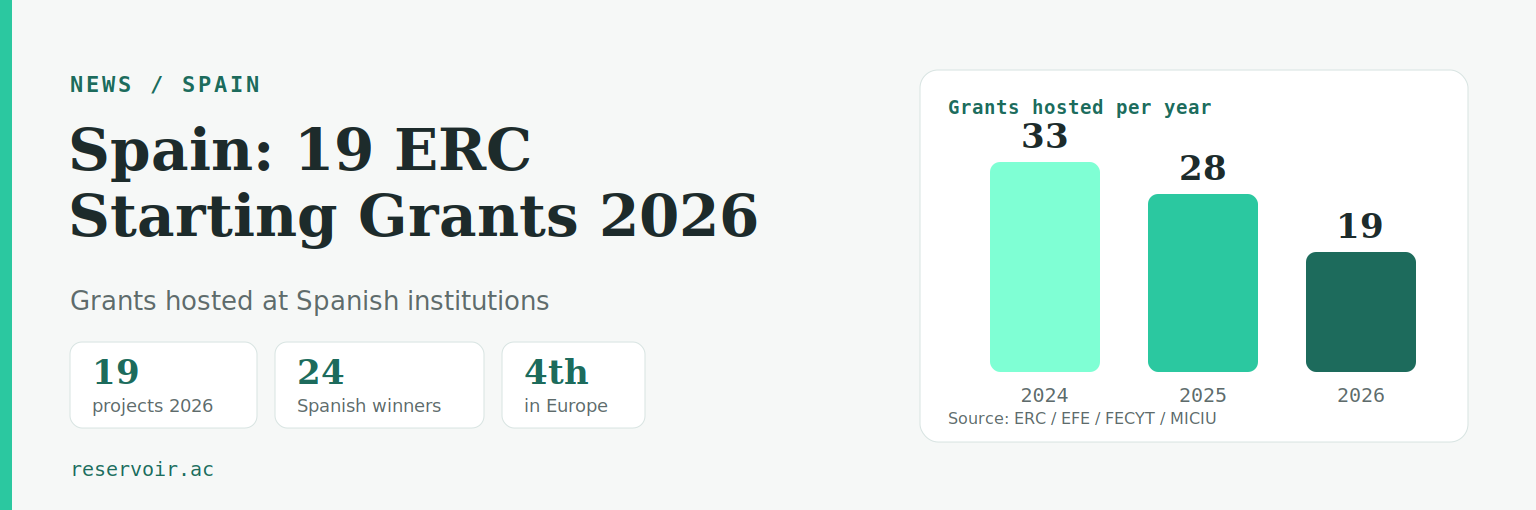
Start with the host country. Spain hosts 19 projects in the 2026 call. In the previous edition there were 28, according to the FECYT European Office, and in 2024 there had been 33 Starting Grant projects run at Spanish institutions, according to the Ministry of Science, Innovation and Universities. The sequence 33, 28 and 19 traces a sustained decline over two consecutive years in the number of grants the country manages to attract to its centres.
Within Spain, the CSIC leads the institutional breakdown. According to EFE, the organisation accounts for four of those projects, followed by the University of Valencia with two, with a presence from centres such as the University of Santiago de Compostela, the University of Granada, IREC, CNIC, Hospital del Mar, the University of the Basque Country, the Complutense University and Carlos III University of Madrid. By field, of the 19 projects hosted in Spain, eight are in Life Sciences, another eight in Physical Sciences and Engineering, and three in Social Sciences and Humanities, again according to the EFE count.
The second lens is nationality, and here the picture is brighter. Among the 421 people awarded across Europe, 24 are Spanish nationals, according to the ERC itself. That places Spain fourth by nationality, behind only Germany with 84, Italy with 50 and France with 30. In other words, there are more Spanish researchers winning a Starting Grant than there are projects hosted in Spain. Part of the talent trained in the country is competing successfully, but doing so from institutions in other countries.
To set it in the European frame: the call distributed 705 million euros, drew a record 4,807 applications and closed with an 8.8 percent success rate. Each grant is worth up to 1.5 million euros over a maximum of five years.
What it means for researchers in Spain
The gap between 19 hosted projects and 24 awarded people is the figure most worth watching. It is not a failure of talent: the nationality numbers show that Spanish research training produces winning applications. It is, rather, a signal about the system's capacity to retain and attract those profiles when the moment comes to choose where to build a team.
For anyone planning a career, there are three practical readings. The first is that the choice of host institution weighs as much as the proposal. A Starting Grant is applied for with a specific centre, and the support that centre offers for preparation, infrastructure and contract conditions shapes the outcome. The second is that mobility is not a demerit: winning the grant abroad and returning later with an established track record is a legitimate path, and schemes like Ramón y Cajal are designed in part for that return. The third is about the calendar: the deadline for the 2027 Starting Grants is 14 October 2026, according to the ERC, so anyone aiming for the next round should already be lining up an institution and a proposal.
A methodological caution is in order. The breakdown by institution and field comes from the agency count of ERC data, not from an official Ministry communication, which in previous editions issued its own release. The European and nationality figures, by contrast, are confirmed by the ERC.
If you want the full European picture of this call, we detail it in ERC Starting Grants 2026: 421 grants and 705 million euros. And if you are interested in the postdoctoral return route in Spain, you can review how the 2026 Ramón y Cajal call changes.
Sources
- European Research Council, official results announcement (3 September 2026): erc.europa.eu
- Agency EFE via Infobae, count of projects at Spanish centres (3 September 2026): infobae.com
- FECYT European Office, Horizon Europe, previous edition results (28 grants): horizonteeuropa.es
- Ministry of Science, Innovation and Universities, 2024 results (33 projects): ciencia.gob.es