What happened
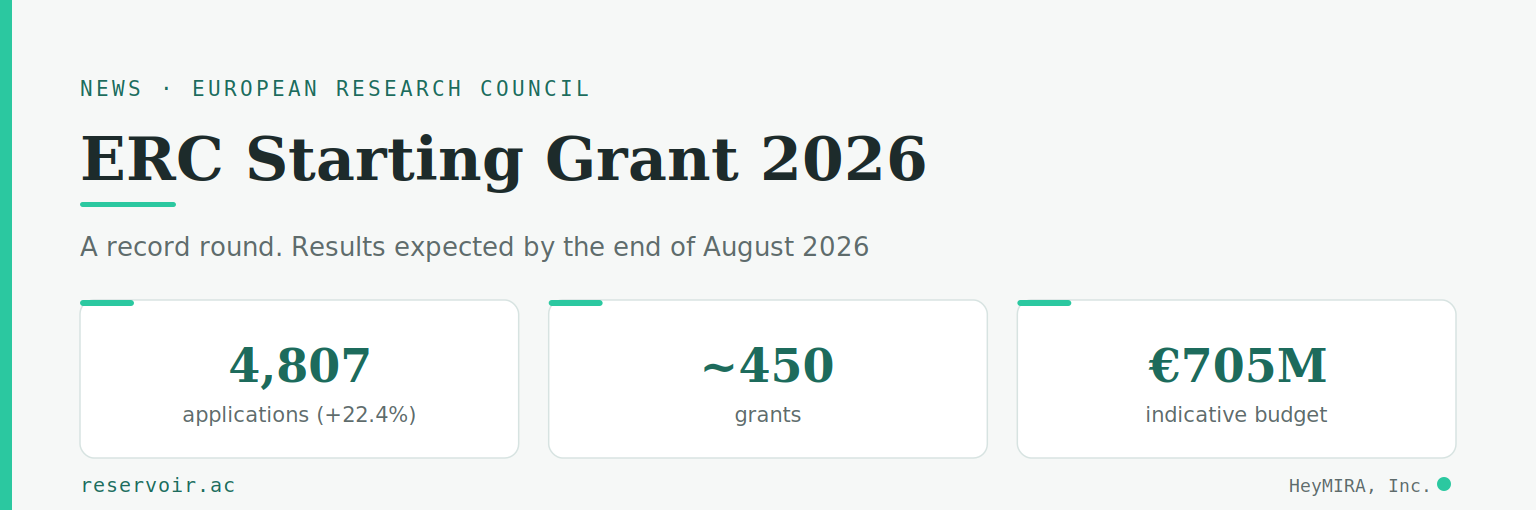
The European Research Council (ERC) reported that its 2026 Starting Grant call attracted a record volume of proposals. The Starting Grant is the ERC's entry door to independent research: it targets researchers between two and seven years after their PhD who want to build their own team and pursue an ambitious, bottom-up project. Evaluation runs in two steps, with panel review and interviews, and the final funding decisions for this round are scheduled to be communicated by the end of August 2026. That places the outcome within reach for the thousands of applicants now waiting.
For anyone in Spain planning an ERC application, the 2026 figures are a useful benchmark of how competitive the scheme has become and a reminder to start preparing the next attempt well before the deadline.
The numbers
The ERC received 4,807 applications for the 2026 Starting Grant call, a 22.4 percent increase over the previous call, which had already risen 13 percent on the year before. The indicative budget is 705 million euros, expected to fund an estimated 450 grants. Each Starting Grant can provide up to 1.5 million euros over five years, with the possibility of additional funding for specific costs such as major equipment or access to large facilities.
The disciplinary split follows the ERC's three domains. Physical Sciences and Engineering led with 1,980 submissions (41 percent), followed by Social Sciences and Humanities with 1,568 (33 percent) and Life Sciences with 1,257 (26 percent). Women submitted nearly 43 percent of the proposals, which the ERC described as the highest share since 2007.
Put together, these numbers describe the most competitive Starting Grant round on record. More applications for a roughly stable number of grants means a lower success rate, and it raises the bar for both the scientific proposal and the way a candidate presents their trajectory.
What it means for researchers
If you are an applicant to the 2026 call, the practical horizon is short. Final results are expected by the end of August 2026, so it is worth having your next steps ready for either outcome. A successful proposal moves quickly into grant preparation and the search for a host institution in Europe. An unsuccessful one is not the end of the road: the ERC runs Starting Grant calls yearly, and reapplication rules, resubmission restrictions and the balance between bottom-up freedom and evaluation criteria are worth reviewing before deciding when to try again.
If you are earlier in your path, the takeaway is about timing and positioning. The two to seven year window after the PhD is narrow, and the strongest ERC profiles are usually built over several years: a coherent research line, a track record of independent contributions, mobility where it adds value, and a proposal that is genuinely high risk and high gain rather than an incremental extension of past work. Spanish host institutions, from universities to research centres and the Severo Ochoa and María de Maeztu units, can strengthen an application, and national programmes such as Ramón y Cajal are often a stepping stone toward an ERC bid.
One honest caveat: the ERC has not yet published the country by country or host institution breakdown for the 2026 cohort in the figures released so far, so any specific claim about the number of Spain based awardees should wait for the official results. When those land, they will tell us how the record demand translated into funded projects across Europe.
For the practical side of preparing a competitive application, keeping a well structured record of your work pays off. You can review our guidance on building an international profile in the piece on research stays abroad and scientific maturity, see how the scheme evolves in what changes in the ERC 2027 competitions, and browse open opportunities in our funding calls section.
Sources
- European Research Council, Starting Grants 2026 applications, facts and figures: erc.europa.eu
- European Research Council, Timeframe Starting Grant 2026 evaluation: erc.europa.eu
- European Research Council, Starting Grant scheme overview: erc.europa.eu