What happened
The Ramón y Cajal call, the main postdoctoral consolidation route in Spain, is being transformed for its 2026 edition. Early in the year, the Ministry of Science, Innovation and Universities announced a reinforcement of the programme with a more international outlook, and over the course of 2026 the State Research Agency (AEI) has spelled out the changes and launched a dedicated web space for the new call.
The core change is structural. Ramón y Cajal absorbs the objectives of the former Consolidación Investigadora call and now offers a single consolidation pathway. The awardee becomes the principal investigator from the start of the contract, with associated project funding. According to the announcement, that package includes the option to hire at least one predoctoral researcher for four years, plus personnel, mobility, equipment and publication costs, following a logic similar to that of the national plan research projects (PID). In practice it stops being just a salaried contract and becomes an incorporation package with its own resources.
The figures
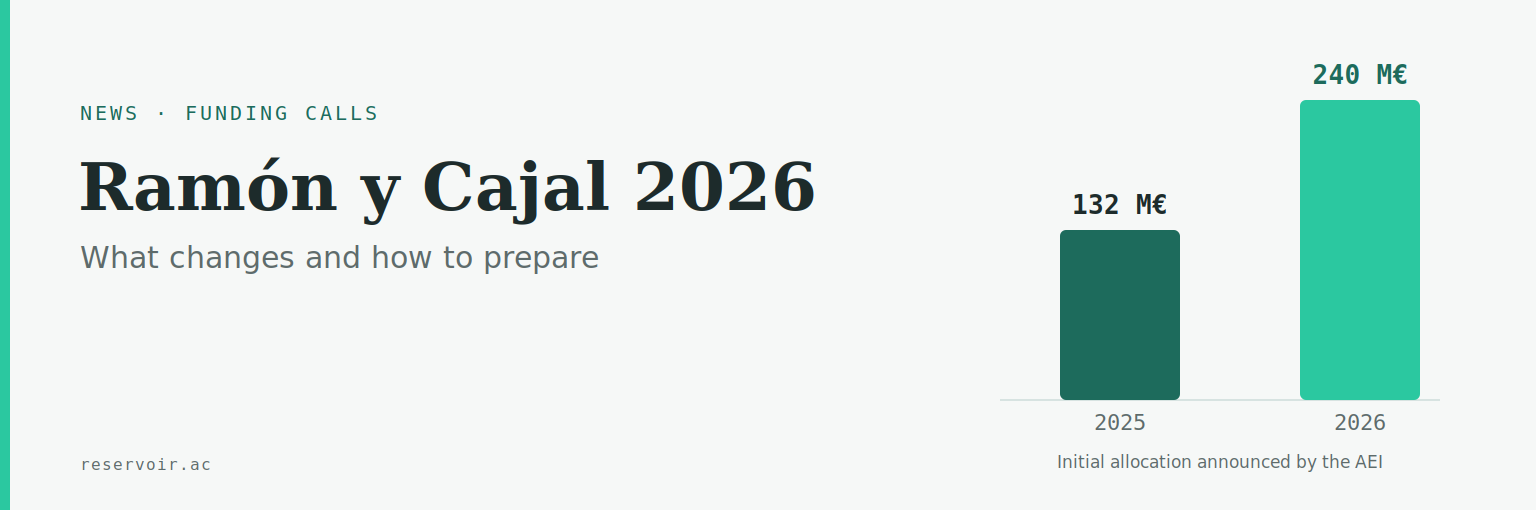
The AEI has announced an initial allocation of 240 million euros for the 2026 call, against the 132 million assigned to the 2025 edition. That is nearly double, though the figure needs care: much of the increase reflects that the programme now also funds what Consolidación Investigadora used to cover, so it is not a like for like comparison.
For a sense of scale, the provisional resolution of the 2025 call, published in June 2026, split those 132 million across 494 contracts. If you read Spanish, our reference page on Ramón y Cajal covers requirements, funding and the stabilization commitment in detail.
The contract keeps its five year duration and its defining feature: the stabilization commitment, meaning the host institution pledges to create a permanent position, supported by a financial incentive.
What changes in the evaluation
This is the novelty that most affects applicants. For the first time, the area technical committees will interview candidates. Evaluation stops resting only on bibliometrics and paper, and adds an oral stage where leadership and the project matter. On top of that, there are incentives tied to reaching milestones in European Research Council (ERC) grants, so a candidate's track record with Europe now counts explicitly.
It is not wise to guess the fine numbers ahead of time. The exact incentive percentages, the scoring scales and the final calendar are set in the call text, published in Spain's official gazette (BOE). According to circulated forecasts, the opening is expected around November 2026. If the ERC route is on your radar, our page on the ERC Starting Grant is a good place to start.
What it means for researchers
For a postdoc entering the consolidation stage, there are three practical takeaways.
First, the abridged CV stops being a formality. If the evaluation includes an interview, the track record you present has to hold up in a conversation, not just in a table. It needs to be impeccable and consistent with what you will defend in person.
Second, the weight given to the ERC rewards planning a European career early. If reaching advanced ERC stages adds points, deciding whether to apply for a Starting or Consolidator Grant stops being parallel to the Spanish career and becomes part of it. The same applies to other individual European routes such as the MSCA Postdoctoral Fellowship 2026.
Third, because you become the principal investigator from day one, the application looks more like a project than a contract. You need to arrive with a fundable idea, not just a strong record.
At Reservoir we work precisely on that problem: store your career once as confirmed blocks and re-project it into each format (Spanish CVA, ERC narrative, project memoir) without rewriting from scratch or inventing anything. When the same track record has to serve both the paper form and an interview, consistency stops being a luxury.
Sources
- Ministry of Science, Innovation and Universities, announcement reinforcing the Ramón y Cajal Programme (February 2026): ciencia.gob.es
- State Research Agency (AEI), the Ramón y Cajal programme launches a web space with the 2026 call novelties: aei.gob.es
- Ministry of Science, provisional resolution of the Ramón y Cajal 2025 call (June 2026): ciencia.gob.es