What happened
On 3 September 2026 the European Research Council (ERC) published the results of its 2026 Starting Grants, the flagship scheme for researchers who are two to seven years past their PhD and ready to step up to principal investigator. It is the call we had been tracking at Reservoir when the application volume became known: that record round now has its winners.
The picture has two sides. Demand keeps rising and competition is tougher than ever. At the same time, the map of who applies is changing: this year the ERC highlights a clear increase in applications submitted from the United States, against a backdrop of uncertainty about science funding on the other side of the Atlantic. Europe, budget constraints and all, once again looks like a destination for talent seeking stability to do research.
For anyone planning a career, the operational message is simple. The Starting Grant remains the main gateway, but more and more people are pushing at that gate. Preparing your application early, with a sharp proposal, matters more than ever.
The numbers
Here are the figures the ERC confirms in its official announcement.
The total budget is 705 million euros for 421 projects. Each grant is worth up to 1.5 million euros over a period of up to five years, an envelope designed to cover the principal investigator's salary, team hiring and research costs.
The call drew 4,807 applications, up from 3,928 the previous year. That is a 22 percent increase and an all-time high for the scheme. With 421 grants out of 4,807 proposals, the success rate stands at 8.8 percent: put another way, more than nine in ten applications are turned down.
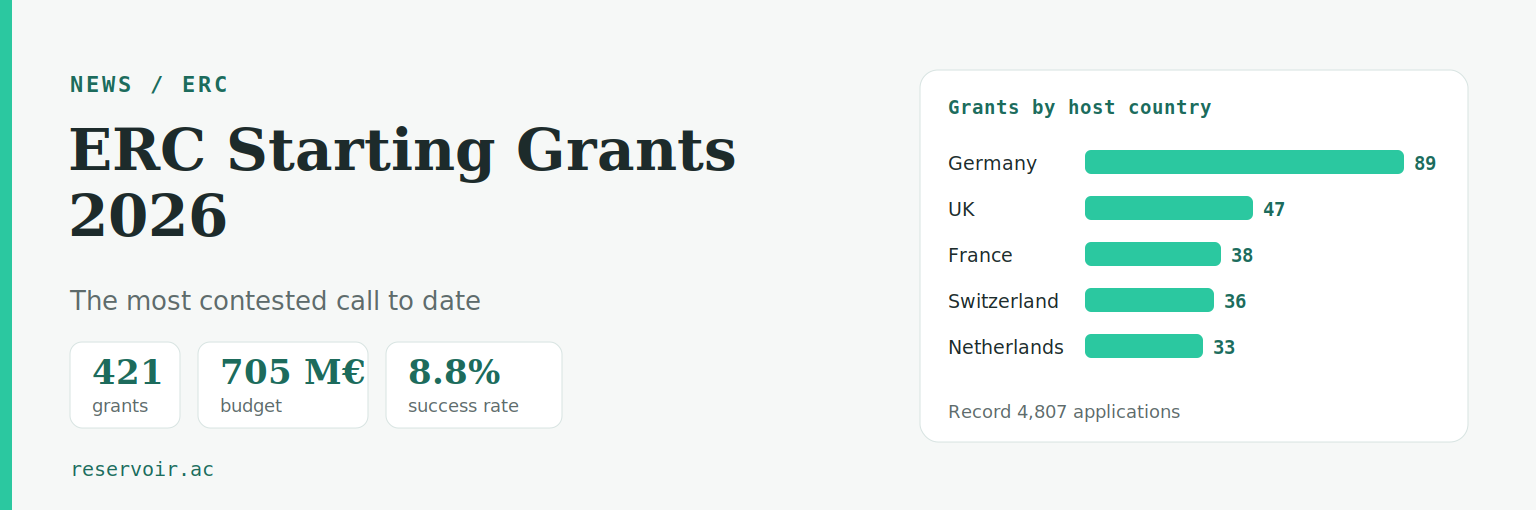
On host country, Germany leads with 89 grants, followed by the United Kingdom with 47, France with 38, Switzerland with 36 and the Netherlands with 33. Grantees represent more than fifty different nationalities. By nationality, the largest group is German with 84, followed by Italian with 50, French with 30 and Spanish with 24, plus researchers of another 48 nationalities.
The point the ERC itself stresses this year is applications from outside Europe. Among the selected researchers there are 21 non-Europeans, around 5 percent of the total, of whom 20 will run their project having applied from the United States. The number of applicants based in the United States rose to 169, up from 116 the year before.
The ERC estimates these projects will create around 2,700 jobs in grantees' teams, spanning postdocs, doctoral candidates and technical staff. That knock-on effect on scientific employment is one reason a Starting Grant transforms not just one career but a whole group.
What it means for researchers
An 8.8 percent success rate forces a dose of realism. A brilliant idea is not enough: you need a proposal that survives a very demanding panel and comparison with the best in Europe. Three practical consequences follow.
First, timing is strategic. Starting Grant eligibility runs from two to seven years after your thesis defence, with extensions for parental leave and other circumstances. Applying too early, before you have an independent track record, or too late, is a common mistake. Map your own window well in advance.
Second, the host institution matters. The country breakdown shows where the most competitive ecosystems are concentrated today. Choosing a centre is not a formality: it shapes the support you get for the application, the infrastructure and the commitment letters.
Third, the next call already has a date. According to the ERC, the deadline for the 2027 Starting Grants is 14 October 2026. Anyone planning to apply is already on the clock. That deadline also overlaps with the deeper changes the agency is preparing for the programme, which we analysed in our piece on the 2027 Starting Grant and the ERC Plus pilot.
If you want to revisit how this call broke its own application record, we covered it at the time in ERC Starting Grant 2026: record applications. The results now published are the outcome of that round.
Sources
- European Research Council, official results announcement (3 September 2026): erc.europa.eu
- European Research Council, examples of 2026 Starting Grants projects: erc.europa.eu
- European Research Council, homepage and calls timeline: erc.europa.eu