What happened
On 20 July 2026 the ERC adopted its 2027 Work Programme through European Commission Decision C(2026)4907. That document sets the rules, the calendars and the new features for every call in the coming cycle. Two days later, on 22 July, the first of them opened: the 2027 Starting Grant, the funding designed for researchers who want to move from working inside someone else's group to leading their own.
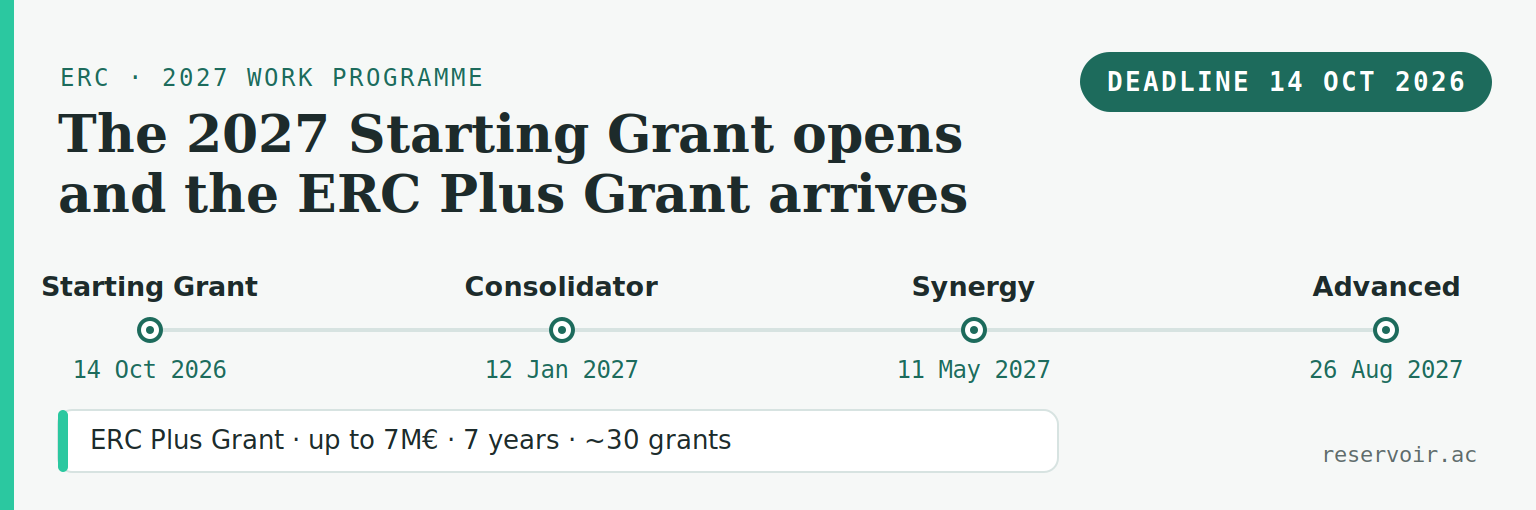
The Work Programme calendar chains the rest of the competitions across the year. The 2027 Starting Grant closes on 14 October 2026. The 2027 Consolidator Grant opens on 24 September 2026 and closes on 12 January 2027. The 2027 Synergy Grant has been rescheduled to open on 17 February 2027, closing on 11 May. The 2027 Advanced Grant opens on 27 May 2027. It is worth confirming each date in the official call on the EU Funding and Tenders Portal, since that is the only binding reference.
The headline change is the ERC Plus Grant, a pilot scheme the ERC frames as its bet to retain and attract top scientific talent. It funds particularly ambitious projects of up to seven years with up to 7 million euros per project. The first competition opened on 2 June 2026 with a budget of 210 million euros under the Choose Europe initiative, and around 30 grants are expected to be awarded.
The figures that matter
The Starting Grant keeps its funding structure: up to 1.5 million euros for a five-year project. On top of that base, applicants can request up to 1 million euros in additional funding for specific eligible costs, such as major equipment or access to large facilities, and up to 2 million euros of relocation support for those moving into the European Research Area from outside it, to a Member State or a country associated to Horizon Europe.
The Starting Grant profile is still, as a general rule, someone with between two and seven years of experience since defending their PhD, with documented extensions for parental leave, illness and, new this cycle, cases of gender-based violence. The exact reference date for counting those years is set by the 2027 Work Programme, so read it in the call before ruling yourself out.
Two procedural changes affect how the proposal is written. The first is the two-part structure: a concise five-page Part I outlining the scientific idea and objectives, and a more detailed Part II. The second is a limit on the number of proposals a single researcher may submit within one Work Programme, meant to keep evaluation fair and efficient. Anyone who received a B in step 1 of the 2025 Synergy call will also face a resubmission restriction.
What it means for researchers
For a postdoctoral researcher in Spain or the wider EU, the 2027 Starting Grant is the doorway to scientific independence, and the deadline is real: 14 October 2026 is less than three months away. A strong ERC proposal is not improvised in September. The five-page Part I rewards clarity of the idea, and that clarity is built earlier, by ordering your own record: what you have proven you can do independently, which publications and responsibilities support your principal-investigator profile, which gap you are going to open.
Widening the grounds for extending eligibility matters more than it looks. Every person counts their years since the PhD differently depending on leave and circumstances, and that calculation decides whether this is your Starting year or whether you should wait for the Consolidator. It is worth doing with the call in front of you, not from memory.
Preparing a European application is, in large part, about re-projecting one career into the format each scheme asks for. At Reservoir we work on exactly that step: confirm your record once and re-project it, without reinventing the facts, into an ERC Part I, a standard CV or a narrative. You bring the scientific idea; the scaffolding can be reused.
If your horizon is consolidation in Spain rather than an immediate ERC, it is worth looking in parallel at how this fits with the 2026 Ramon y Cajal call and the internal MSCA 2026 deadlines. And to place the whole European cycle in context, the debate on where Europe's next research funding stands is still open.
Sources
- European Research Council, new 2027 Work Programme: erc.europa.eu
- ERC, applying in the 2027 competitions: erc.europa.eu
- ERC, first ERC Plus Grant competition opens: erc.europa.eu
- ERC, 2027 Work Programme (PDF, Decision C(2026)4907): erc.europa.eu
- ERC Starting Grant call profile on Reservoir: /funding-calls/erc-starting-grant