
A controversy has flared up in Spain over the Juan de la Cierva fellowships, the country's flagship postdoctoral scheme, about how much a research stay abroad should weigh in a researcher's evaluation, and, underneath that, about how a young scientist's "potential" should be judged at all. The names are Spanish, but the question belongs to every research system in Europe: from how national agencies score mobility to how the pan-European Marie Skłodowska-Curie fellowships assess independence, the same logic repeats almost everywhere. The debate is usually framed as a clash. Read carefully, the two sides share far more than they appear to. And that, precisely, is the key.
We agree more than it seems
The more senior position, which defends qualitative evaluation by expert judgement, makes points that are hard to refute. That what truly matters in a researcher (independence, maturity, judgement of one's own, potential) does not fit cleanly into a rubric. That the usual quantitative indicators, such as the journal impact factor or quartiles, measure badly and sometimes measure the opposite of what they claim. That a stay abroad is an immensely valuable means of growing, but not the only one. And even, in the words of those who defend it best, that having done a stay does not in itself prove that someone has matured.
It is worth pausing here, because it is decisive: that last idea is not the objection to our thesis, it is our thesis. The person who defends the value of the stay and the person who warns of its limits are, at bottom, saying the same thing: what we want to recognise is scientific maturity, and the stay is only one of the forms, an imperfect one, of approaching it.
If there is so much agreement, where is the disagreement? In one specific and often invisible point. The senior position trusts that an evaluator with judgement will be able to read real maturity beyond the data. And it is right that a good evaluator can. The problem is that the system, taken as a whole, does not run on that ideal: it needs something countable, comparable, defensible on appeal, and down that slope it has ended up turning the means into the end. It does not measure maturity. It measures its easiest-to-count shadow: months away.
The problem is not valuing maturity. It is substituting the stay for it
That this is not a suspicion can be seen in the scoring criteria themselves. In the formal mobility-stay section of ANECA's accreditation system, only stays lasting three months or more are countable; shorter visits may contribute to an international trajectory, but they do not count as research stays in that specific section, and to be accredited as a tenured professor or full professor one must accumulate six and twelve months of stays respectively, plus a mobility minimum (ANECA, ACADEMIA 2024). The detail is Spanish, but the shape is familiar across the continent, where mobility expectations are baked into national accreditations and into the eligibility rules of European programmes alike. It is worth distinguishing between levels: the most rigid example appears in ANECA, where the formal stay section sets defined time thresholds; in calls such as Juan de la Cierva, mobility is assessed more qualitatively as part of the candidate's trajectory. But the underlying incentive remains similar: to make scientific maturity visible through stays, internationalisation, and certifiable collaborations. What is counted, and therefore what is pursued, is long, continuous absence. The intense, repeated, short international collaboration, the coming-and-going that is perfectly possible today and that produces visible results and progress, on many occasions more, and of better quality, than a long stay, barely registers in that formal section.
And there the substitution is consummated. We began wanting to measure intellectual maturity and we ended up measuring months of passport. The means has become the end, not because anyone decided it in bad faith, but because a large system always tends to replace what matters and is hard to measure with what approximates it and is easy to count. Whoever defends the stay describes very well what a good stay contributes. What the system has done with that description is something else: it has frozen it into a requirement.
To see why that is a mistake, we have to ask exactly what it was we wanted to measure.
What scientific independence really is
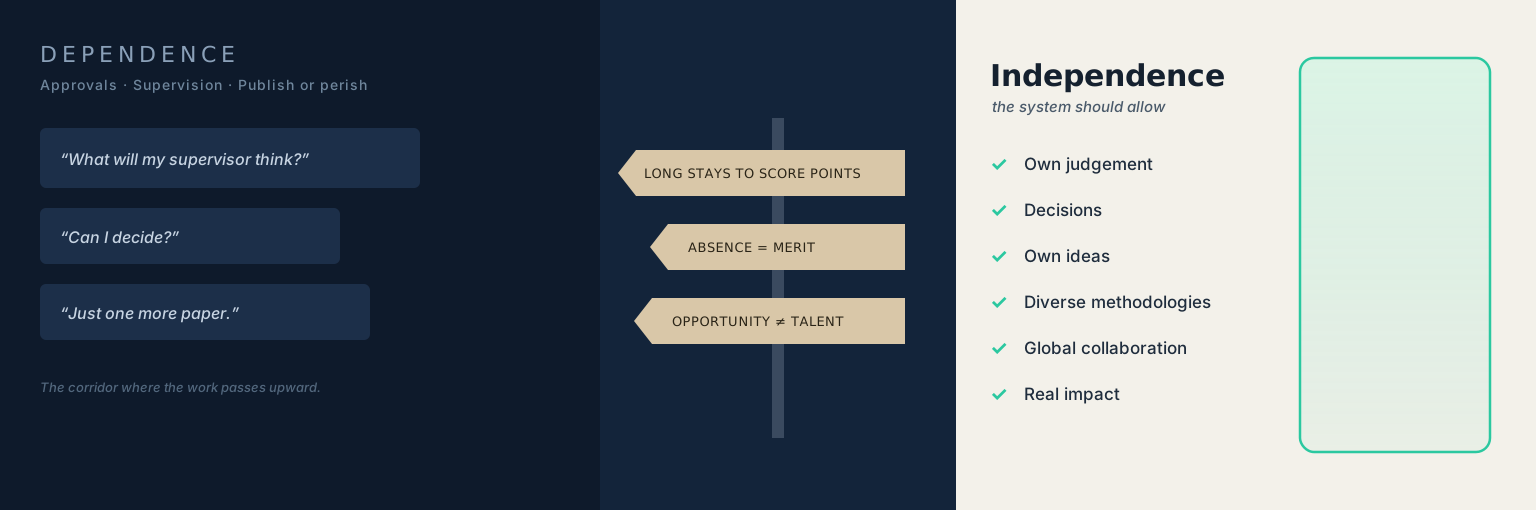
The independence we are talking about is not a formality or an administrative box. It is a psychological process, slow and often uncomfortable, and almost none of it is visible on a stay certificate.
It begins with something as simple and as difficult as learning to disagree with your supervisor: daring to defend a result, a method or an interpretation in front of the person who holds power over your career. That requires a safety to dissent that hierarchy and precarity erode precisely when you need it most. It continues with the development of judgement of one's own: knowing which questions are worth asking and trusting your own sense of what is solid, without outsourcing that confidence upward. And it culminates in the passage from executing other people's ideas to generating your own, and taking responsibility for them.
That process has a silent enemy, harder to name because it does not look like an order. The newcomer often arrives better prepared than their environment in very concrete things: a language, a recent technique, a statistical or programming tool learned when the senior had stopped learning any. And yet it is their work that gets rewritten. Their style is corrected, their paragraphs reworked. Something curious happens: sometimes the senior was right, as is only logical, and the junior comes to admit it later; other times the correction added nothing and was simply an absorption of the supervisor's style. But the effect, in both cases, is the same, and it is the one that matters: the junior learns to distrust their own judgement before even defending it with the force that winning that autonomy would require, and ends up abdicating it.
And there is a still subtler version, almost invisible, that is not imposition but simulated debate. The idea is discussed, opinions are invited, the junior feels they are genuinely taking part, and yet the supervisor's criterion ends up being applied, often without the junior realising they have given way. It is autonomy as a gift: an autonomy granted with one hand and withdrawn with the other. Discuss it all you like; I will make a point of listening, but since I have more judgement, I have no doubt you will end up doing what I would have done 98% of the time. That is, perhaps, the most effective form of dependence, because it is experienced as agreement. And, paradoxically, the young researcher needs that agreement, because their career depends on the very person they are debating positions with; so, if they want to stay, they are in no position to take a line of their own, even when it would be the right one. They are not free.
That is why the most important idea in this whole debate is also the simplest to state. Scientific independence does not arrive the day a researcher crosses a border. It arrives the day they stop asking themselves what their supervisor would think before making a decision. And that day may never come even after crossing ten borders, or it may come without leaving one's own city. It is not read off a passport stamp: it is recognised, if at all, in the voice with which someone defends what is theirs. You can spend two years in a prestigious lab executing someone else's programme brilliantly and come back having never once owned a question. And you can build all of it without leaving, in the right group, with a mentor who lets you argue. The stay neither guarantees maturity nor is indispensable to it; and that, far from contradicting whoever defends stays, confirms their best argument.
The autonomy paradox: the system trains dependence and then demands independence
If that is how independence is built on the inside, it is worth looking at what the system does on the outside. And what it does is uncomfortable: the very system that demands independence is designed, in parallel, to make it harder.
Consider how a newcomer actually works. Every piece of scientific output (every article, every poster, almost every grant application) passes through the supervisor's validation, usually over several rounds, and ends up shaped to their criterion and style. The work unfolds inside a project the junior did not design and whose funding they do not control. The application process for many of these grants depends on the endorsement of an institution, a supervisor, a host group, or a chain of institutional approvals. Even when the current supervisor is not formally the one signing, early-career researchers rarely operate in a fully autonomous space. To which a silent detail is added: the principal investigator appears as an author, often the senior or corresponding author, on almost all of the team's output, so that the junior's work feeds above all the metrics of the person directing it.
To that appropriation of credit a subtler one is added: the appropriation of language. It is not unusual for the group's discourse to be built in the first person plural: "they didn't give us the grant", "we need to get this paper out". The plural sounds like a team, and sometimes it genuinely is one. But it often disguises an enormous asymmetry: the application belongs to the newcomer, the effort is that of the young researcher who executes it, the sleepless nights are theirs, and the "we" appears above all to share out a credit that was, for the most part, one person's, or to wrap in the language of care a decision that suits the group more than the person carrying it. Learning to say "I" when the work has been yours is also, and it is no small thing, part of building a voice of your own. It is a form of reclaiming autonomy.
None of this is an isolated perception. A review of research-career development guidance concluded that the influence of the principal investigator and the closed scope of projects prevent young researchers from developing their independence, and called for "training independent minds" (Times Higher Education). A qualitative study of more than a hundred early-stage researchers described a system that fails to treat them as independent (Research Policy, 2024). And it has been noted for years that independence, far from being encouraged, is sometimes discouraged, because the postdoc works on someone else's grant and cannot take that work to a lab of their own (Future of Research).
The finest example is the Marie Skłodowska-Curie scheme itself, one of Europe's most prestigious. Among the things assessed is the researcher's potential to reach a position of maturity and independence; yet the proposal is built jointly with the supervisor, the one at the host centre, and the quality of that supervision is a central evaluation criterion (MSCA-PF Handbook 2025). Independence is assessed within a framework that, paradoxically, depends on a formal relationship of hosting, supervision, and institutional fit.
So the situation is this: the system trains, for years, the subordination of one's own judgement, first administratively and, more deeply, mentally, and then it asks for proof of judgement of one's own, and as proof it accepts above all a single datum, the months away, which does not measure that either. An "independence demonstrated" within that frame reflects, in large part, whether your supervisor let you lead, their generosity and your luck in choosing them, more than your capacity. You cannot make something harder, fail to measure it well, and still demand it by way of its substitute.
Thirty years ago it made sense. Today, much less
It is worth understanding why the long stay came to occupy that place, because there was a time when it made complete sense. Thirty years ago, when science in much of southern Europe was poorer and far more isolated, going abroad was almost the only way to break with a single scientific school, to see other methods, other working cultures, other ways of thinking about a problem. The goal was never to travel. The goal was to be exposed to other ways of thinking, and back then that exposure barely fit anywhere but in a suitcase.
That world no longer exists, neither intellectually nor in terms of life circumstances. Intellectually, diversity now has far more points of entry. Any technology company operates with its staff spread across different time zones without trouble: video calls, shared repositories and workspaces, team messaging tools that replace the corridor. Science has exactly those same tools and finds it enormously hard to use them. Online conferences, for instance, cut the carbon footprint of an event by around 94% and measurably widen diversity and inclusion, because they let people with caring responsibilities, a disability or scarce funds take part, though it is true they lose the social side, which is probably more interesting than the 80% of talks that, by their topic, are of no concern to you. Even so, the sector showed notable resistance to adopting them the moment it could fly again (Nature Communications, 2021; Times Higher Education).
And in terms of life circumstances, it is worth remembering what that journey consisted of then and who it is being asked of now. Those who left three decades ago often did so from a different position in life: with more stability, on occasion even with a permanent post already on the horizon, or with a real certainty of being hired afterwards, not rarely accompanied by their families. The person now required to do the stay is around thirty, on a precarious contract and without a safety net, and is being asked for rather more than a professional relocation: to break for one or two years with their family and their friends, to give up their hobbies in many cases, to dismantle the life they have barely begun to build. Travelling from security is not the same as emigrating from precarity, and the scoring grid treats the two as if they were the same merit.
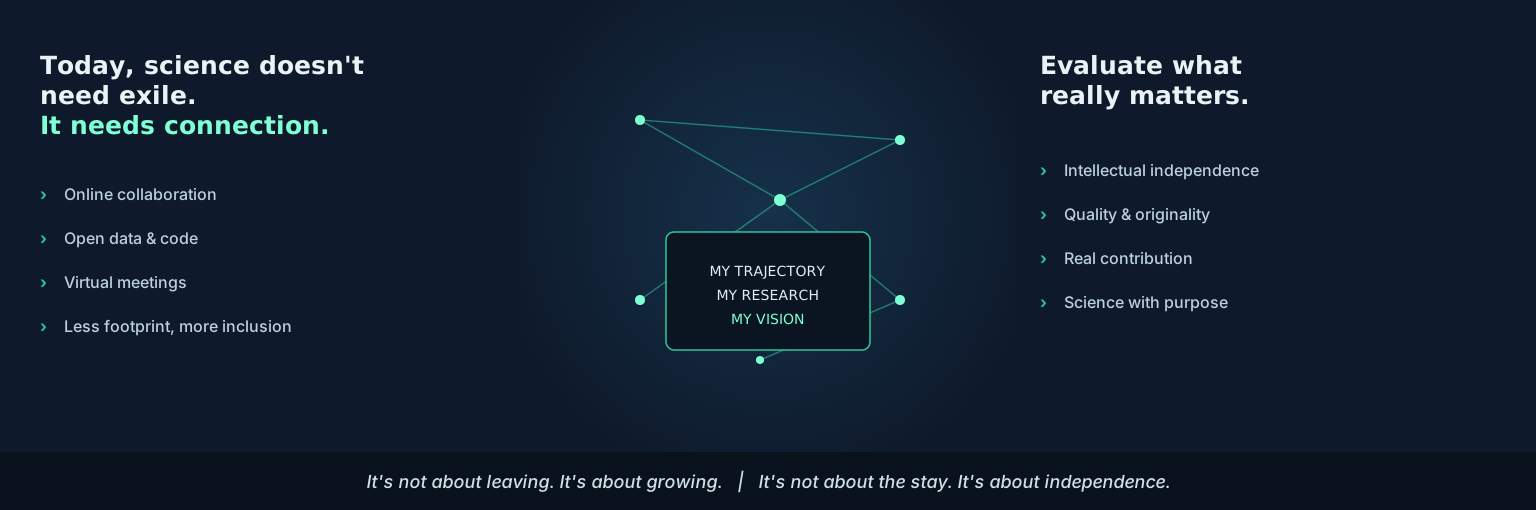
The paradox closes here: just as more efficient, more inclusive and often equally enriching ways of being exposed to other schools have appeared, the criteria still reward the most expensive and exclusionary form, and discard the rest with a zero. This is not to deny that a good stay still contributes; it still does. It is that the system has mistaken the only road of thirty years ago for the compulsory road of today, and has stopped asking what that road was for. It wanted diversity of thought; it now certifies kilometres.
And the one who only wanted to stay and do science
There is, besides, a profile the system harms in a particular way, precisely because it does not fit its story. Not everyone enters science dreaming of a nomadic career that alternates positions across different research groups or private companies. There are those who, without that subtracting an ounce from their talent or their rigour, do not experience their research line as a personal banner, nor the conference circuit as a goal, beyond what it offers as a reunion with people and socialising with colleagues. What truly moves them is at once simpler and deeper: doing good work in a place where they feel at home, putting down roots in a lab, in a team, in a way of working, and with people, that suit them and to whom they contribute.
For a long time we have treated that desire as a lack of ambition. It is almost the opposite. It runs with much of what we know about how knowledge takes hold: continuity, deep mastery of a system, the trust accumulated within a group and the long memory of a problem are conditions of good science, not symptoms of conformism. Wanting to stay where one performs best can be the most productive decision, not the most comfortable one.
And yet the scoring grid reads rootedness as a red flag. It turns the wish to remain into a suspicion, forces a choice between the place where one does their best work and the career that claims to reward precisely that work, and ends up driving the person away from the only thing they asked for: to stay and do it well. It is the quietest form of the same confusion. A system that says it seeks good science ends up pushing out the very person who had the psychological and environmental conditions to do it, only because their life map did not include a stamp in the passport.
Who pays for that confusion
Substituting the stay for maturity is not a neutral mistake: it has concrete victims, and it is worth naming them.
It is paid, first, by whoever cannot move in one block for a year. It is true that those who do long stays tend to accumulate more citations, but that correlation reflects, in large part, who can leave, with what support, with what network, without what burdens, rather than some magical effect of the plane. Measured that way, the stay measures opportunity, not talent, and turns a head start into a finishing-line advantage. And the irony becomes almost cruel when you read the small print: maturity-by-leaving is demanded of people who are around thirty and have spent years in precarious conditions, with reference salaries that for years remained frozen or insufficiently updated relative to the real cost of building an autonomous life, assuming they are lucky, because it has become a matter of luck, enough to even hold a contract that matches their professional category, and merits often accumulated by working for free (Público; El Salto, in Spanish). The same system that denies the material autonomy to build a dignified life inside the country then demands proof of autonomy by tearing that life up by the roots. Autonomy-to-leave is praised in those who have not been granted autonomy-to-stay.
It is paid, too, by science itself, in a subtler way. When the criteria are largely set, judged and administered by the same group that already cleared the barriers, any closed system tends, without need of bad faith, to reproduce those barriers rather than lower them. In Spanish universities that has a name and numbers: in 2014, around 73% of faculty had trained at the same institution that later hired them, and analyses of specific calls have found more than 80% of certain posts going to candidates from the department itself (Xataka Magnet, in Spanish). Academic inbreeding is not a uniquely Spanish vice, but Spain has measured it unusually well. Some argue it is not inbreeding but the economic logic of each centre; even granting that, if selection depends on criteria only the committee understands, the line between logic and favouritism is drawn by whoever evaluates, with no external check possible.
And here, once again, the agreement with the senior position is greater than it seems. Because the alternative to the stay-as-substitute is not the impact factor, which is just as poor a substitute. Measuring by quartiles is a textbook case of Goodhart's law: when a measure becomes a target, it stops being a good measure, and it has filled science with perverse incentives, from slicing results into the least publishable unit to multiplying courtesy co-authorships (PNAS, 2025; Research Evaluation, Oxford). Out of that same critique came the San Francisco Declaration (DORA) and the Leiden Manifesto. The upshot of all of it, bad substitutes above and below, is that the researcher ends up spending their energy optimising what is measured instead of doing science, trapped in a race where the indicator weighs more than the scientific question.
There is another way to use experience
To say all this without offering a way out would be unfair, as unfair as settling for the situation and drifting into assuming that this is just how it is. It is not just how it is. The barriers we are talking about were put up by people, and people can take them down. And whoever has experience and power within the system is, precisely, the one who can do most.
Because would it not be a far more coherent role for an experienced researcher to help their people build several distributed stays, of a little over three months each, which clear the scoring threshold comfortably and often enrich more than a single two-year block, and to fund them with whatever it takes? Would it not be more coherent to fight much harder for stable funding so that someone who genuinely commits, feels at home and performs outstandingly in the group does not live in fear of the gaps between contracts, even if that means far more work chasing money? That is the version of mentorship that actually builds independence: the one that uses power and experience to remove obstacles, not to administer them.
The underlying question is uncomfortable, and it is worth asking out loud. Are we designing the early-career path thinking about what genuinely makes the person grow and what makes them happy, because yes, happiness in one's work is also critical, or are we administering it with an eye on what suits the group best, at a cost that for the senior is small and from which they will moreover keep harvesting the fruits, while the one who carries the effort and the uprooting is always the same person, in the name of an autonomy we never let them exercise? Asking it is not a reproach: it is the litmus test of whether a group and a system are truly at the service of science and of those who do it, or at the service of other interests, no less legitimate, but different.
We are not arguing about whether travelling is good
It is worth ending by making clear what this is and is not about. We are not arguing about whether going abroad is good; it almost always is. We are not pitted against those who value maturity; we want to measure it as much as they do, or more. We are arguing about one thing only, far more sober and far more serious: whether the research system is really measuring what it says it wants to measure, or has settled for its most convenient shadow.
And the answer, today, stings a little. Because intellectual maturity is real, recognisable, and exactly what science needs, and the system had the chance to learn to spot it in all its forms: in the person who built it abroad and in the one who built it at home, owning their decisions and allowing themselves to fail until they forged a judgement of their own that is, in itself, the truest proof of having grown; in the long stay and in the brief but intense collaboration, in the journey and in the independent mind that needs no plane but makes the most of one like no one else. Instead, it keeps certifying months. Every time we mistake the means for the end we lose exactly what we said we were looking for: we leave out mature researchers because they matured by the wrong road, and we let opportunity in, dressed up as talent. This is not a discussion about plane tickets. It is the difference between a system that recognises independence and one that merely counts its cheapest signs. And as long as we fail to resolve it, we will keep asking young people to cross borders to prove a freedom we never, deep down, let them exercise at home. But none of this is a law of nature: it is a choice we make, collectively and personally, every time we evaluate, supervise or fund. And it can be chosen differently.
Sources
- Misalignment of incentives in academic publishing (publish or perish, authorship as currency). PNAS, 2025: https://www.pnas.org/doi/10.1073/pnas.2401231121
- "Call to give early career researchers more independence" (Concordat review; "training independent minds"). Times Higher Education: https://www.timeshighereducation.com/news/call-give-early-career-researchers-more-independence
- Transitioning to independence: a system that "fails to treat them as independent". Research Policy, 2024: https://www.sciencedirect.com/science/article/pii/S0048733324001604
- Achieving independence in research career transitions. Future of Research: https://www.futureofresearch.org/2019/03/22/achieving-independence-in-research-career-transitions/
- Job autonomy and performance (meta-analysis, 300+ studies, 150,000+ participants). Academy of Management: https://journals.aom.org/doi/10.5465/AMBPP.2019.145
- MSCA-PF Handbook 2025 (supervision as a central criterion; proposal built jointly with the supervisor): https://horizoneuropencpportal.eu/sites/default/files/2025-06/radiance_msca_pf_2025_handbook.pdf
- ANECA ACADEMIA 2024 criteria (three-month minimum stay; six and twelve months for tenured and full professor): https://participa.aneca.es/processes/evaluacion-meritos-competencias/f/2/
- Virtual and hybrid conferences: carbon-footprint reduction of around 94%. Nature Communications, 2021: https://www.nature.com/articles/s41467-021-27251-2
- Virtual conferences, equity and inclusion. Times Higher Education: https://www.timeshighereducation.com/news/carbon-footprint-virtual-academic-conferences-revealed
- Reference salary (Juan de la Cierva and Ramón y Cajal) frozen since 2011. Público (in Spanish): https://www.publico.es/ciencias/subida-salarial-empleados-publicos-afectara-investigadores-doctorados-falta-regulacion.html
- Precarity and "working for free" to accumulate merits. El Salto (in Spanish): https://www.elsaltodiario.com/precariedad/investigadores-denuncian-universidades-se-quedan-parte-salario
- Academic inbreeding in Spain (around 73% trained at their own institution). Xataka Magnet (in Spanish): https://www.xataka.com/magnet/plazas-bicho-convocatorias-amanadas-problema-endogamia-universidad-espanola
- Goodhart's law and perverse incentives in research evaluation. Research Evaluation, Oxford: https://doi.org/10.1093/reseval/rvag023