If you searched for "MSCA deadline 2026", here is the short answer: the HORIZON-MSCA-2026-PF-01 call opened on 9 April 2026 and closes on 9 September 2026 at 17:00 CEST, with a budget of 399.05 million euros and nearly 1,600 projects expected to be funded. So far, this is what any official page will tell you.
The long answer is the one that actually decides whether you make it: that date is not your date. An MSCA-PF is not applied for alone. The proposal is submitted jointly by the researcher and the host organisation, and it is written in close collaboration with the prospective supervisor. That turns the application into a two-stage process, and the first stage has its own deadlines, different at every institution, and almost always months before September.
The pre-application: winning over your host institution
Before writing a single line of the official proposal, three things need to be resolved: finding a centre and a supervisor that fit your line of research, defining with them what project you will propose using the instruments and capabilities of that specific place, and convincing them to submit the application with you. Institutions know this, and many have formalised that early phase with internal "expression of interest" calls and their own draft-review calendars.
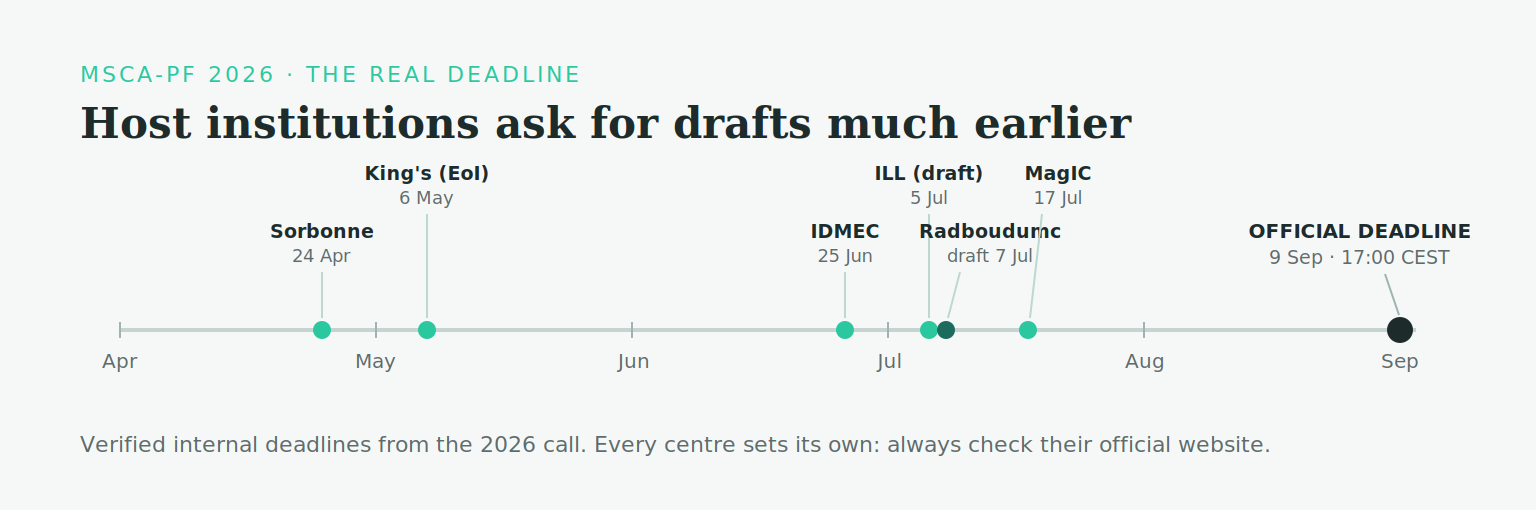
This is not an exception at a couple of places; it is the norm. Some verified examples from the 2026 call:
- The Alliance Sorbonne Université (France) closed its internal MSCA-PF call on 24 April 2026, more than four months before the official deadline.
- Radboudumc (Netherlands) asked for expressions of interest by 30 April, runs workshops in May and June, requires a first draft proposal by 7 July and a final draft by 12 August for review by the national contact point.
- King's College London (UK) closed its internal expression-of-interest process on 6 May.
- IDMEC at Instituto Superior Técnico (Lisbon) asks for an expression of interest, including a short draft of the proposal, by 25 June.
- The Institut Laue-Langevin (Grenoble) set 5 July as the deadline to submit the draft project to its European office.
- The MagIC research centre at NOVA IMS (Lisbon) accepts candidacies with a proposal abstract until 17 July.
The pattern is clear: for half of Europe, the "September deadline" has already passed or expires in the coming weeks. Whoever discovers the call in August is not late for the European Commission; they are late for their host institution, which is worse, because without a host there is no application.
Why institutions move the dates forward
This is not gratuitous bureaucracy. Institutions that take the MSCA seriously offer expert review of your draft, writing workshops, mentoring from former fellows and their supervisors' time. All of that takes weeks. A supervisor who receives a draft on 1 September can contribute nothing; one who receives it in July can transform the proposal. The programme's own numbers explain the demands: it is highly competitive, and the quality of the early collaboration with the host shows in the evaluation.
There is also an incentive worth knowing: if your host institution is in a "Widening" country (Portugal, among others), a single application can also be considered for the ERA Fellowships without resubmitting, which increases your chances with the same effort.
The real cost: writing a competitive draft in weeks
Here is the crunch that almost nobody mentions when talking about the "September deadline". If your host asks for the draft in mid-July, your real calendar looks like this: identify and contact supervisors in June, agree on the project idea in two or three weeks, and produce a solid draft (excellence, impact, implementation, plus your CV in the programme's format) in a handful of days, usually while finishing something else: a thesis, a contract, a paper.
The raw material for that draft already exists: your publications, your methods, your research stays, your previous projects. The problem is that it is scattered across documents, CV versions and old reports, and reassembling it under pressure is where the days are lost. This is exactly the problem we built Assemble for, Reservoir's application module: you store your career once as structured blocks, Assemble reads the specific call and proposes a draft built from your real material, flagging the gaps instead of inventing them. You confirm every piece. A first draft that would take weeks can come out in days, leaving time for what actually improves an MSCA: review rounds with your supervisor.
What to do this week if you are applying to the 2026 call
- Choose whom to contact based on track record, not catalogues. Supervisors you have already collaborated with, or centres your group has a relationship with, respond more and better. A cold expression of interest competes against dozens; one with shared context does not.
- Check each candidate centre's "research/EU office" page now. Search for "MSCA expression of interest" or "internal deadline". If they do not publish dates, write and ask: having their calendar is having your calendar.
- Propose a project designed for that place. Proposals win when they use the instruments, techniques and networks of the destination centre. That requires reading what they have before writing what you will do.
- Have your material ready to be re-projected. CV in the programme's format, publication list, summary of methods and research stays. Every centre will ask for it with small variations and little margin.
- Reserve August for polishing, not starting. The dates above speak for themselves: whoever starts in August writes without review. Whoever delivers a draft in July reaches September with a well-worked proposal.
Sources
- Official MSCA Postdoctoral Fellowships 2026 call (opened 9 April, closes 9 September 2026, 17:00 CEST; budget €399.05M; ~1,600 projects): European Commission, marie-sklodowska-curie-actions.ec.europa.eu and European Research Executive Agency, rea.ec.europa.eu
- "6 steps to prepare your application" guide (joint application with the host organisation): marie-sklodowska-curie-actions.ec.europa.eu
- Alliance Sorbonne Université internal deadline (24 April 2026): sorbonne-universite.fr
- Radboudumc internal deadlines (EoI 30 April; first draft 7 July; final draft 12 August): radboudumc.nl
- King's College London internal deadline (EoI 6 May 2026): kcl.ac.uk
- IDMEC / IST Lisbon internal deadline (EoI 25 June 2026): EURAXESS, euraxess.ec.europa.eu
- Institut Laue-Langevin internal deadline (draft 5 July 2026): b2match.com
- MagIC / NOVA IMS internal deadline (17 July 2026): magic.novaims.unl.pt