What happened
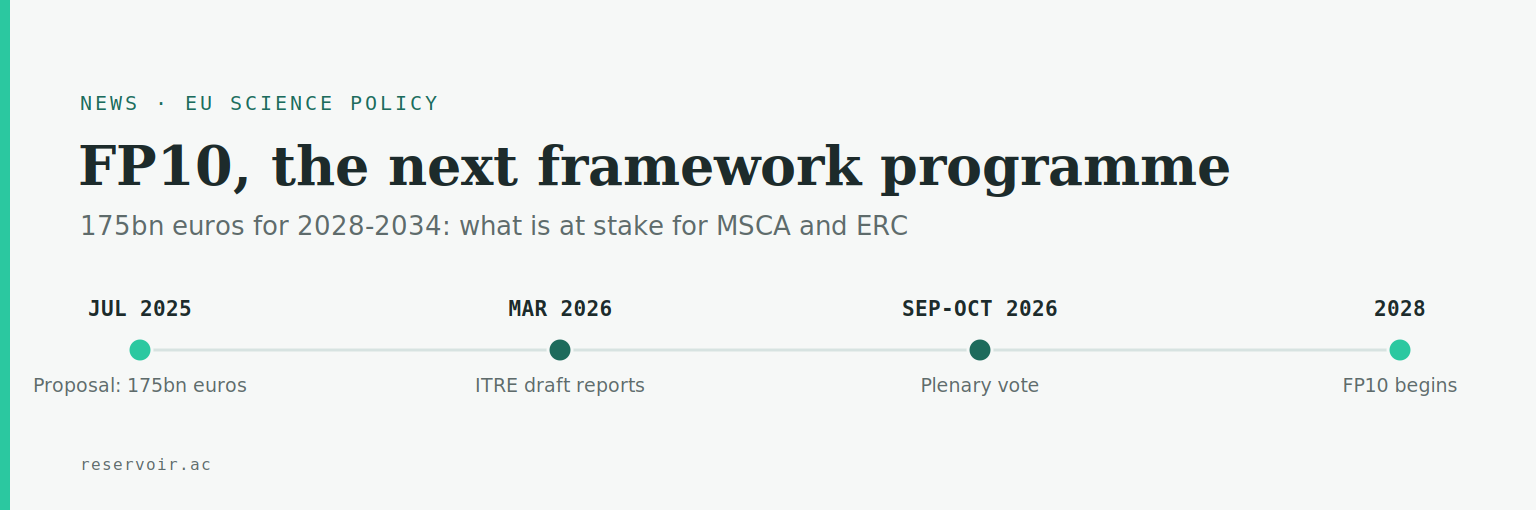
In July 2025, the European Commission put forward its proposal for the next research framework programme, provisionally called FP10, which will succeed Horizon Europe over 2028-2034. The headline figure was 175 billion euros, nearly double the roughly 93.5 billion of the current Horizon Europe.
A year later, in the summer of 2026, the conversation in Brussels is no longer about size but about architecture. And that is where the conflict sits.
The fine print: "standalone", but inside a larger fund
According to the Commission's proposal, FP10 would be a standalone initiative, yet placed within a European Competitiveness Fund (ECF) worth 409 billion euros. That double status, standalone and at the same time embedded, is the root of the debate. Analysis by Science|Business has estimated that around 68 billion euros of research money would sit inside the Competitiveness Fund rather than in FP10 itself, which has set off alarms across the research community about the border between science and industrial policy.
Organisations such as Science Europe, LERU and The Guild have spent months arguing that FP10 must be a genuinely separate programme, with its own budget and excellence based governance, rather than one more line inside a fund oriented toward competitiveness.
Structure and figures
The proposal keeps a pillar logic. According to the Commission, FP10 would be organised into four: Excellent Science, Competitiveness and Society, Innovation, and the European Research Area (ERA). Within that scheme, the Commission has proposed doubling the budget of the European Research Council (ERC) and tripling that of the European Innovation Council (EIC).
For researchers, the key lies in the first pillar. Excellent Science is where both the ERC and the Marie Skłodowska-Curie Actions (MSCA) have always lived, the two European routes that matter most for individual careers. Whether that pillar is preserved, and with what funding, is what will decide whether Europe keeps funding talent on excellence or lets that logic dilute.
Where the timeline stands
The legislative process is under way. In March 2026, the European Parliament's Committee on Industry, Research and Energy (ITRE) presented its draft reports: rapporteur Christian Ehler on the Horizon Europe regulation and René Repasi on the specific programme. The amendment deadline was set for April 2026 and the plenary vote is expected around September or October 2026. Negotiation with the Council will follow. Nothing is final until that path closes.
What it means for researchers
In the short term, nothing changes. Horizon Europe remains in force and its calls run their course. If your plan is an MSCA Postdoctoral Fellowship or an ERC Starting Grant in the next two years, you apply under today's rules, not FP10's. We cover the current conditions in our ERC Starting Grant and MSCA Postdoctoral Fellowship 2026 pages.
In the medium term, three readings. First, the pledge to double the ERC, if confirmed, points to more places and a competition that will stay intense but with a little more room. Second, the fight to keep FP10 separate from the Competitiveness Fund is, at bottom, a fight to keep basic science and individual careers from being subordinated to industrial priorities. Third, it is worth following the process, because the design for 2028 is being decided now.
In the meantime, the sensible thing is not to lose sight of the immediate: the internal deadlines of European calls tend to catch people by surprise. We explain them in our note on the MSCA 2026 internal deadlines.
Sources
- European Commission, Horizon Europe (current framework programme): research-and-innovation.ec.europa.eu
- European Commission (IP Helpdesk), Horizon Europe to continue beyond 2027 with increased budget and new four-pillar structure (28 July 2025): intellectual-property-helpdesk.ec.europa.eu
- Science|Business, coverage of FP10 planning: sciencebusiness.net
- European Parliament, ITRE committee, draft reports on FP10 (March 2026): europarl.europa.eu