What happened
The R3 certificate comes from article 22 bis of Spain's Science, Technology and Innovation Law (Ley 14/2011), as rewritten by Ley 17/2022. The State Research Agency (AEI) issued the call for the second year running through the Resolution of 24 April 2026 of its Presidency, published in the official gazette, with a submission window from 19 May to 9 June 2026. It is therefore an annual call: anyone who missed this year's window has the next edition ahead, and it is worth preparing the application months in advance.
The R in R3 points to the European classification of researcher profiles, from R1 to R4. R3 is the established-researcher stage: the person able to develop their own line of work independently, attract funding and lead groups and projects. The certificate translates that European profile into official recognition inside the Spanish system, with concrete effects on access to posts.
The numbers and the requirements
What makes the R3 matter is not an amount but three effects fixed in law. First, it is recognised in stable-hiring processes at universities, public research organisations and other eligible entities. Second, it allows part of the merit-evaluation phases in those processes to be waived or offset. And third, it reserves posts: a minimum of 25 per cent of the researcher scales at public research organisations and a minimum of 15 per cent of university teaching bodies are reserved for those who hold the R3.
The entry requirements draw a precise picture of who it targets. You must hold a doctorate obtained before 1 January 2021 and show postdoctoral experience through one of three routes: at least 2 years on a research-doctor access contract, at least 3 years in publicly funded postdoctoral programmes, or at least 5 years of postdoctoral employment, including work carried out abroad. It also requires mobility of two years or more in stays at different institutions, with minimum stays of one month. Those who already hold a permanent university teaching post or a public-research-organisation researcher post, or who already hold an R3 or I3 certificate, are excluded. The application carries no fee.
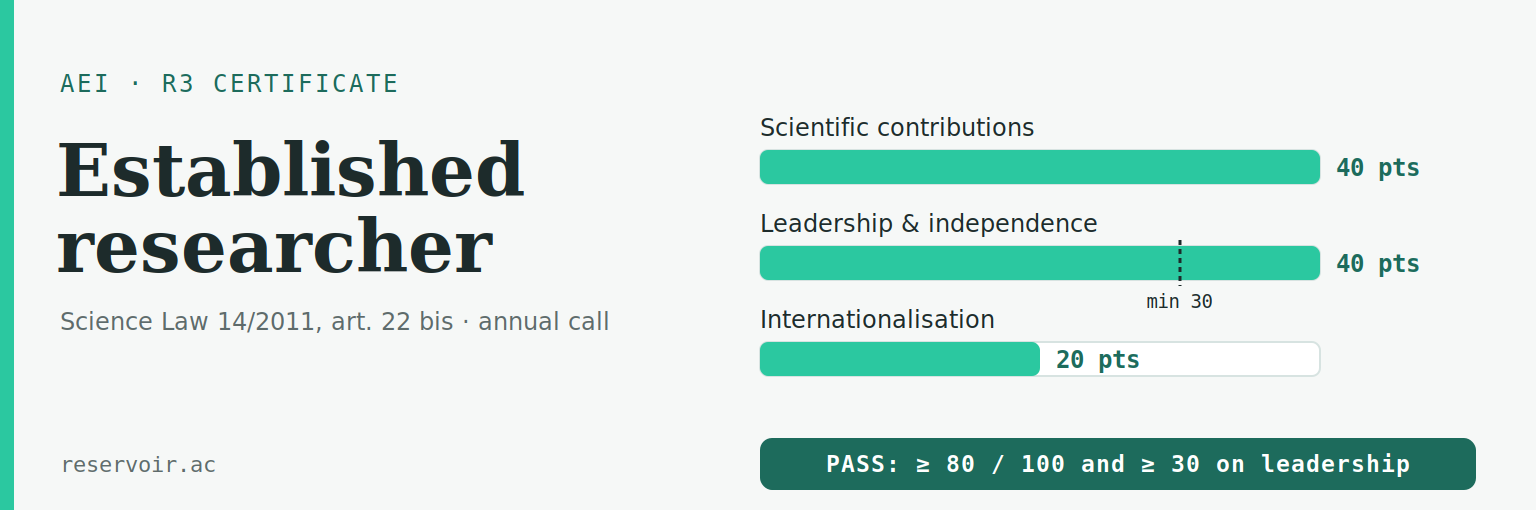
Evaluation is played out over 100 points across three criteria: scientific contributions up to 40 points, leadership and independence up to 40 points, and internationalisation up to 20 points. To pass you must total at least 80 points and, in addition, reach a minimum of 30 points on the leadership and independence criterion. That double threshold is the reading key: a strong publication list is not enough without demonstrated autonomy as a principal investigator.
What it means for researchers
For a postdoctoral researcher, the R3 is a planning piece, not a last-minute formality. The Spanish system has spent years shifting the weight of evaluation away from counting papers and towards demonstrating independence, and the R3 leadership criterion, with its compulsory 30-point floor, is the clearest expression of that turn. The same logic appears in the new design of Ramon y Cajal 2026 and in how a research stay abroad is read today: what is valued is not having been away, but the maturity it demonstrates.
In practice, preparing the R3 forces you to do something uncomfortable but useful: rebuild your own career with exact contract dates, months of stays and leadership responsibilities, and order the evidence so each criterion is supported. That reconstruction is the same one an ERC, an ANECA accreditation or a national call demands, only in a different format. At Reservoir we work on exactly that: confirm your record once, with its dates and its evidence, and re-project it into the format each application requires, without reinventing any fact. The R3 paperwork stops being wasted effort and becomes the reusable core of everything else.
The operational advice is simple. If your doctorate and your track record fit the requirements, do not wait for the next opening to start: check today whether you meet the experience and mobility routes, gather the supporting documents and work on the independence narrative. You can cross-check dates and deadlines against the rest of the funding calls so the R3 fits your stabilisation calendar.
Sources
- Official gazette, Resolution of 24 April 2026 of the AEI Presidency, R3 certificate call (BOE-A-2026-9869): boe.es
- State Research Agency (AEI), R3 Certificate 2026 call: aei.gob.es
- Ministry of Science, Innovation and Universities, R3 Certificate 2026 record: ciencia.gob.es
- Science, Technology and Innovation Law 14/2011 (article 22 bis): boe.es