What happened
In late July 2026, Spain's Ministry of Science, Innovation and Universities published the provisional resolution of the FPU grants (Formación de Profesorado Universitario), the country's best known predoctoral entry route. An FPU grant is a contract of up to four years to complete a doctoral thesis at a public university or research centre.
The administrative headline is routine, just another provisional resolution. The real headline is different. FPU 2025 offers fewer places than FPU 2024, on a smaller budget, and it arrives at a moment when demand keeps rising. The result is a funnel that narrows year after year, with cut-off marks breaking records and rejected applications now counted in the thousands.
It helps to separate two things. One is this year's resolution, with its concrete numbers. The other is the underlying trend, which is what really matters to anyone thinking about applying for a predoctoral grant in 2026 or 2027.
The numbers
The comparison between the two most recent calls is direct and can be verified in the Ministry's own announcements.
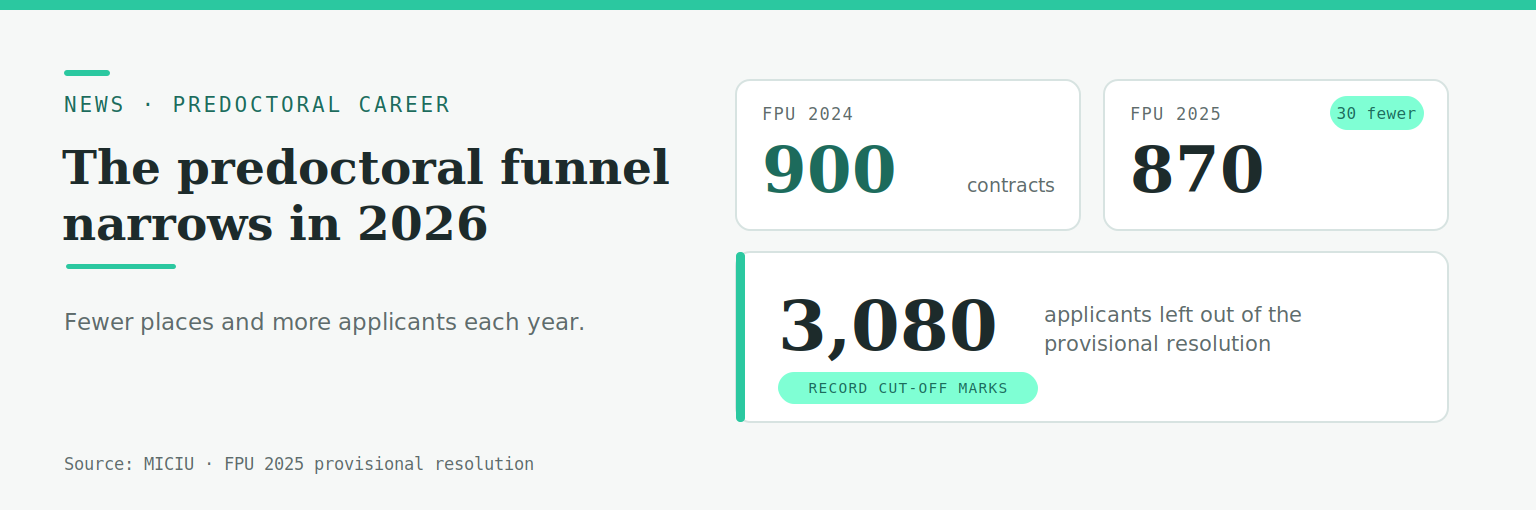
FPU 2024 approved up to 900 predoctoral contracts, with an initial allocation of around 123 million euros, as the Government stated when it launched the call. FPU 2025 comes in at 870 contracts, of which 43 are reserved for people with a disability of 33 per cent or more, on a maximum multi-year budget of 120.87 million euros. That is thirty fewer places and just over two million euros less from one year to the next.
On individual funding, the terms set a minimum annual salary of 25,116 euros for the contracted researcher, and the scheme keeps the mobility stay of one to three months. The application window for this call was open between 16 January and 14 February 2026.
The figure that lit up the debate this week is not the number of places, but the number of exclusions. According to reporting by the newspaper Público based on the provisional resolution, roughly 3,080 applicants were left out of the proposal. The same analysis points to record cut-off marks in several fields, with thresholds in Social and Behavioural Sciences and in the Languages area sitting above 92 out of 100 on the current scoring scale. Historical comparison is tricky because the scoring scale has changed over the years, so these figures are best attributed to the outlet that reports them and read as a signal of the trend, not as a homogeneous series.
Looking ahead, the Ministry has announced that FPU 2026 will come with simplified procedures and better planning. Público places its opening around 20 October 2026. If confirmed, that date leaves a long gap between calls and concentrates even more pressure on each place.
What it means for researchers
The reading for a future predoc is not doom, but it does call for realism. Getting in through FPU is more competitive every year, and the score depends on a rubric in which the academic record and the fit with the receiving team weigh heavily. Fewer places with more applicants means that missing the provisional resolution will be, for many excellent applications, the norm rather than the exception.
That is why it makes sense not to stake everything on a single call. The system offers other predoctoral doors with different timelines and criteria: the FPI grants tied to funded projects, the predoctoral contracts of the Instituto de Salud Carlos III for the biomedical field, the predoctoral grants of several autonomous communities, and universities' own programmes. Each has its own rubric and deadline, and none hands out enough places to absorb, on its own, the demand that FPU leaves out.
The other consequence is about the calendar. If FPU 2026 does not open until the autumn, personal planning becomes critical: it pays to have the academic paperwork, the group's backing and the project outline ready well in advance, because application windows are short and overlap with other calls. Preparing a strong application, rather than relying on a single date, is today the best defence against a funnel that keeps narrowing.
For the wider policy backdrop on what Spain now requires of its universities and their research, see our piece on the university decree and research requirements, and browse the open routes in the funding calls section.
Sources
- Ministry of Science, Innovation and Universities, approval note for the FPU 2024 call (up to 900 contracts, 123 M euros): ciencia.gob.es
- Ministry of Science, Innovation and Universities, FPU 2024 (900 researchers, more than 123 M euros): ciencia.gob.es
- Ministry of Science, Innovation and Universities, news on the FPU 2026 call: ciencia.gob.es
- State Research Agency (AEI), FPU grants: aei.gob.es
- Público, analysis of the FPU 2025 provisional resolution (fewer places, record cut-off marks, 3,080 left out), 28 July 2026: publico.es