Spain had 33 public universities and 4 private ones in 1983. By September 2025 the count was 50 public and 46 private, and the ratio keeps moving: the Madrid region alone already has 13 private universities versus 6 public ones. Against that backdrop, the Government approved Royal Decree 905/2025 in October 2025, changing the conditions to create, recognise and maintain universities. The rule shook the sector at the time and the debate remains alive, rekindled by data such as the recent IUNE 2026 report on the imbalance between teaching and research.
What the decree requires
The main requirements, according to the text published in the Official State Gazette and the Ministry's official information:
- A binding quality report. Authorising new universities now requires a favourable, binding report from ANECA (Spain's quality agency) or the regional quality agencies. Previously, unfavourable reports did not block approval: since 2018, ministry experts issued 21 negative reports, and several of those universities were created anyway.
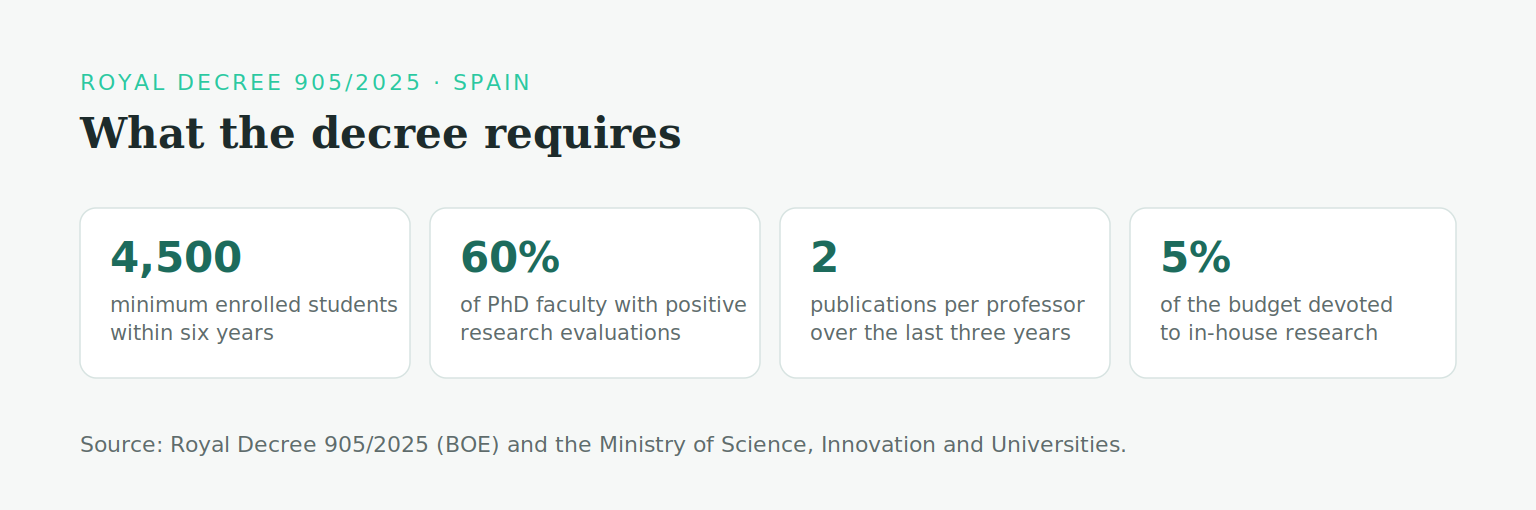
- Critical mass. A minimum of 4,500 students enrolled in official degrees within six years, and more undergraduate than master's students (with an exception if at least 65% of master's students are international).
- Research requirements. At least 5% of the budget devoted to in-house research programmes; after seven years, a minimum of 60% of PhD-holding faculty with a positive evaluation of their research activity (ANECA or regional agencies); and an average of at least two scientific publications per professor over the last three years.
- Faculty and residence. At least half of the faculty full-time and 60% holding a PhD. Mostly online universities (over 80% of credits taught virtually) must guarantee that at least 75% of their teaching and research staff reside in Spain, and their recognition goes through the national Parliament.
- Material guarantees. A bank guarantee covering the third year's budget and student housing capacity equivalent to 10% of undergraduate places.
The controversy
The rule was presented as a defence of system quality, with the official argument that private growth is especially intense in high-demand degrees (a third of health-sciences bachelor's degrees and 62% of master's degrees are already taught privately) while the underfunded public system raises admission cut-offs. Critics counter that applying new requirements to already-authorised universities borders on retroactivity, that the 4,500-student threshold would push out more than a dozen small institutions operating today, and that size and quality are not synonyms.
It is a legitimate debate with serious arguments on both sides. What admits little discussion is the underlying diagnosis: the decree itself acknowledges that the previous recognition system allowed universities to be created against technical quality criteria.
The research-career reading
For researchers, the decree has a practical consequence that gets little attention: it turns research into a condition of institutional survival for private universities. If 60% of PhD faculty must hold positive research evaluations and each professor must average two publications in three years, universities that until now competed only on teaching need to recruit and retain accreditable research profiles. That creates demand for researchers with evaluable track records in a segment that barely had it, and gives ANECA evaluations and sexenios new weight outside the public system.
The other side: the requirement arrives without changing the conditions that make research hard under heavy teaching loads. Meeting the decree on paper is easy; building environments where research actually happens is not. The coming IUNE reports will show whether the private sector's 10.4% share of scientific output starts to move.
Sources
- Royal Decree 905/2025, of 7 October (full text): Official State Gazette, boe.es
- Official note from the Ministry of Science, Innovation and Universities (binding ANECA report, health-sciences data): ciencia.gob.es
- Sector analysis and context: democrata.es and eldiario.es