What happened
The Ministry of Science, Innovation and Universities (MICIU), through the State Research Agency (AEI), has released the provisional resolution of the 2025 Generation of Knowledge projects call. This is the backbone of Spain's competitive, non-oriented research funding: the grants that sustain most groups at public universities and research centres, and the vehicle through which a large share of predoctoral contracts (the funded positions that let researchers start a thesis) are awarded.
The ministry frames the call as the best funded since the programme began, placing it above the previous edition in both budget and number of applications. It is a provisional resolution, not a final one: an allegations period opens before the firm awards are published, so the figures may still be adjusted in the definitive version.
The numbers
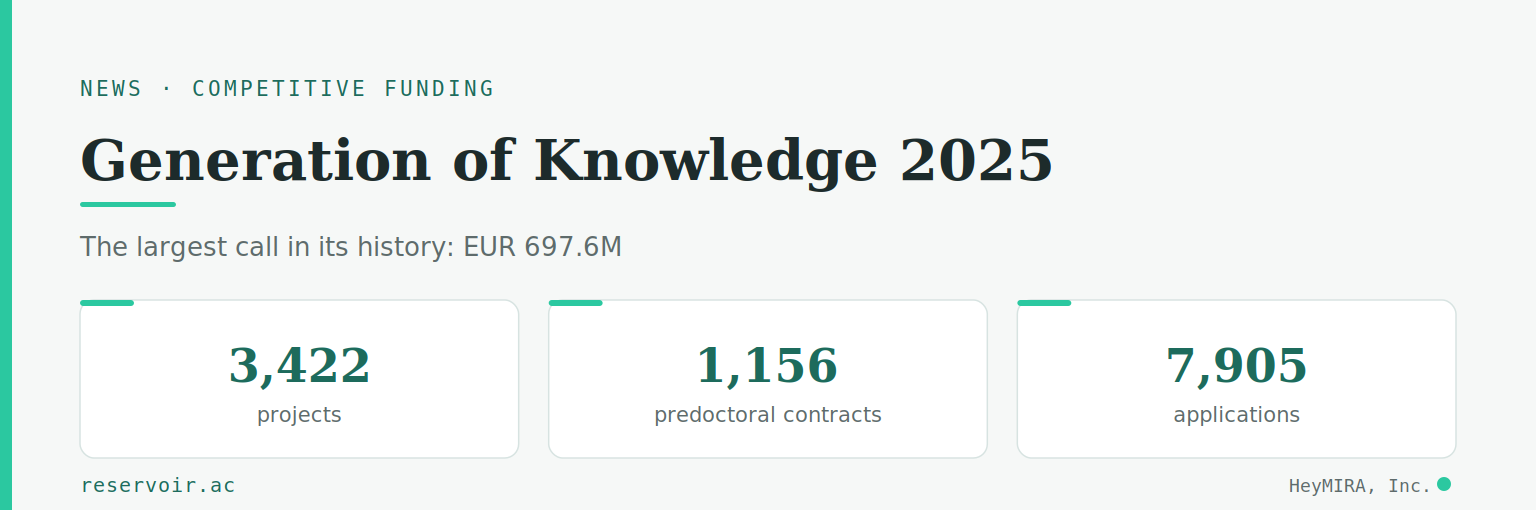
The overall budget reaches 697.6 million euros. Of that total, roughly 542 million funds 3,422 research projects and about 155.6 million funds 1,156 predoctoral contracts attached to those projects. The call received 7,905 applications, up from 7,190 in the previous edition.
The split by modality shows the weight of each career stage. Type B projects, led by more consolidated researchers, total 2,930 (around 86 percent). Type A projects, reserved for young researchers, number 441 (close to 13 percent). The remainder are oriented projects, with 51 proposals (about 1 percent). According to the ministry, 52 percent of the pre-awarded research plans include at least one woman as principal investigator.
The year on year comparison helps read the trend. The 2024 edition, resolved provisionally in July 2025, mobilised 667 million euros for 3,252 projects and 1,149 predoctoral contracts. The 2025 jump is roughly 30 million more, 170 additional projects and a demand that grows by more than seven hundred applications. The predoctoral contracts, by contrast, stay almost flat: seven more positions than the previous year, a detail that matters to anyone planning the start of a thesis.
What it means for researchers
For a predoctoral candidate, the reading is twofold. The good news is more money and more active projects, which widens the base of groups able to host and fund new work. The less good news is that project linked predoctoral contracts barely grow: 1,156 positions against almost eight thousand project applications reflect a well known bottleneck at the entrance to the research career in Spain, already visible in programmes such as the FPU.
For those in a postdoctoral phase or leading a group, the message is one of opportunity and deadlines. Because this is a provisional resolution, it is worth reviewing the status of each application in detail, checking the assigned budget and preparing allegations where appropriate within the window that the AEI opens. The definitive resolution will follow and will set the firm terms for execution, staff recruitment and spending schedule.
Two cautions are in order. First, the nominal award lists contain personal data: to check your own situation, always use the official electronic office and the official publication, not third party copies. Second, the modality percentages and the figure on female participation come from the ministry's communication about the provisional proposal and may change in the definitive resolution.
If you are preparing to join a newly funded project or to apply to the next call, keeping your track record in order (projects, publications, contributions and merits) saves weeks of work when it is time to fill in forms and the standardised CV. You can see how this call fits the wider calendar in our funding calls section and review the postdoctoral context in our analysis of the new Ramón y Cajal 2026.
Sources
- State Research Agency, note on the 2025 Generation of Knowledge call: aei.gob.es
- Ministry of Science, Innovation and Universities, press note (15 July 2026): ciencia.gob.es
- Year on year reference, 2024 provisional resolution: ciencia.gob.es
- AEI calls finder: aei.gob.es