The Marie Skłodowska-Curie Postdoctoral Fellowship (HORIZON-MSCA-2026-PF-01) is the European Union's flagship postdoctoral grant, and one of the hardest to write, because reviewers judge your project and your track record at the same time. This guide walks the whole thing end to end: from building your career record once, to exporting a submission-ready package for the EU Funding & Tenders (SEDIA) portal. The 2026 call closes on 9 September 2026; always confirm details on the official portal.
What makes the MSCA PF different (and hard)
The MSCA PF is not scored like an ordinary grant. Three weighted criteria carry the whole evaluation:
| Criterion | Weight | What it covers |
|---|---|---|
| Excellence (1.1) | 50% | Research objectives, soundness and novelty of the methodology; training and two-way knowledge transfer between researcher and host |
| Impact (1.2) | 30% | Credibility of the impact pathway, dissemination, communication and exploitation |
| Implementation (1.3) | 20% | Work plan, resources, risk management and the host environment |
Here is the catch that trips up first-time applicants: reviewers do not read your project and your CV in separate passes. They evaluate both at once: every claim about the science is weighed against the researcher who will deliver it. A brilliant project attached to a thin track record loses points; a strong record with a vague work plan loses just as many. That is exactly the problem Reservoir solves: your career record and your proposal sections live in one place, so the evidence behind every claim is one click away.
Step 1: Build your career store once
Reservoir starts with you, not the call. Connect your ORCID and import your record from PubMed, Web of Science or Scopus, or upload your méritos PDF and let the extractor pull it apart. Everything lands as structured blocks: Bio, Education, Positions, Publications, Mobility stays, Awards.
These blocks are the raw material for every section of every future application, written once, reused forever. Each block carries its source (e.g. “from: ORCID”), its dates, its language and its tags. You confirm what goes in; only confirmed blocks feed your drafts and CV.
Tip: already have blocks? Skip ahead. The more complete your blocks, the stronger your AI drafts. Your fit score and section scores both read directly from what is in here.
Step 2: Find the MSCA in Compass and check your fit
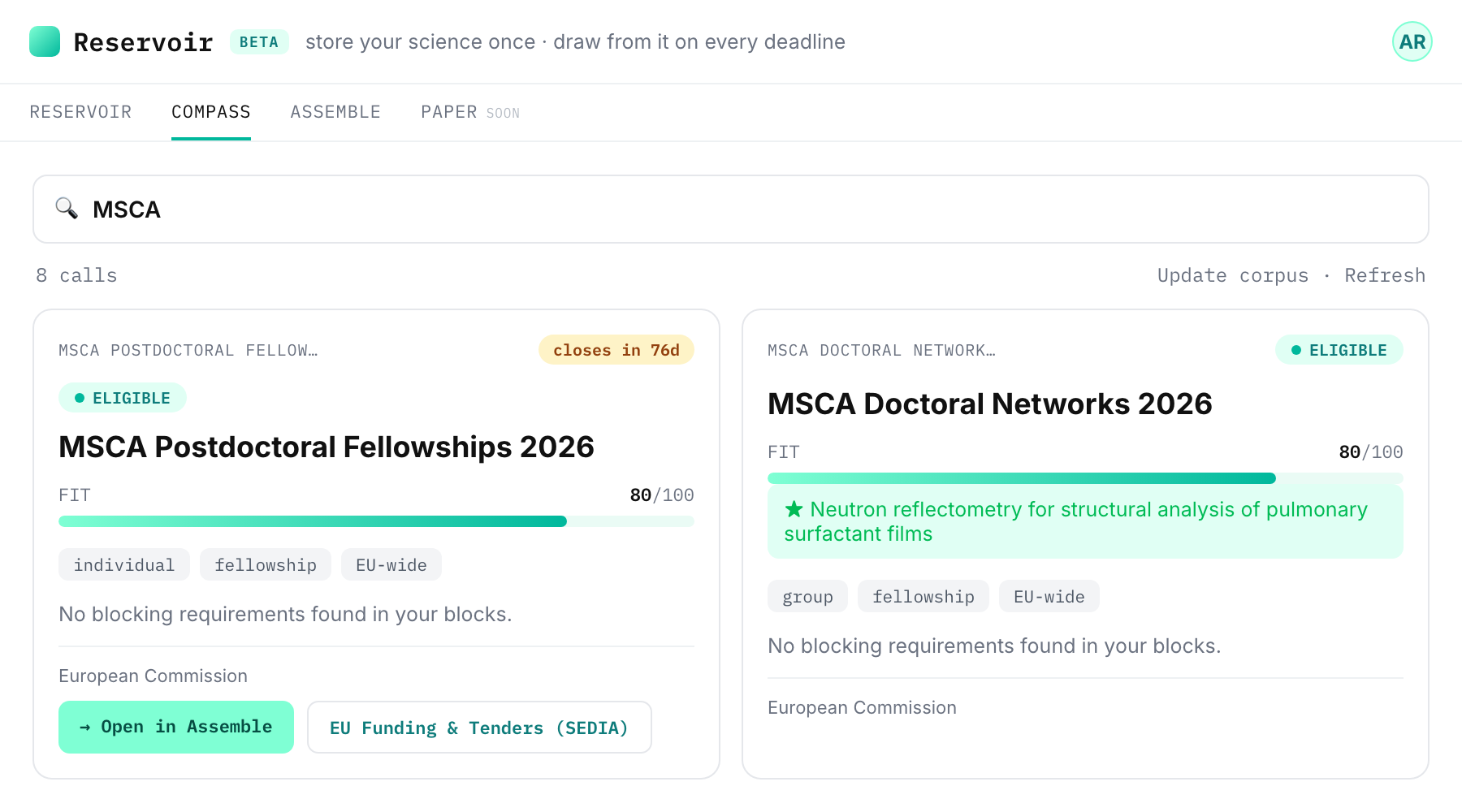
Open Compass and type “MSCA” in the search. MSCA Postdoctoral Fellowships 2026 appears with an ELIGIBLE badge and a FIT score of 80/100, alongside the note “No blocking requirements found in your blocks.”
What does Fit mean? It is computed live from your confirmed blocks against the call's requirements: degree level, mobility, publication record, host setup. It is not a promise of funding; it is a readiness signal that shows, before you invest a single evening, how much of the call your record already covers and where the gaps are.
Green means go. “No blocking requirements found in your blocks” means you pass all the automated eligibility checks Reservoir can run from your record.
Step 3: Open in Assemble and let Reservoir build the skeleton
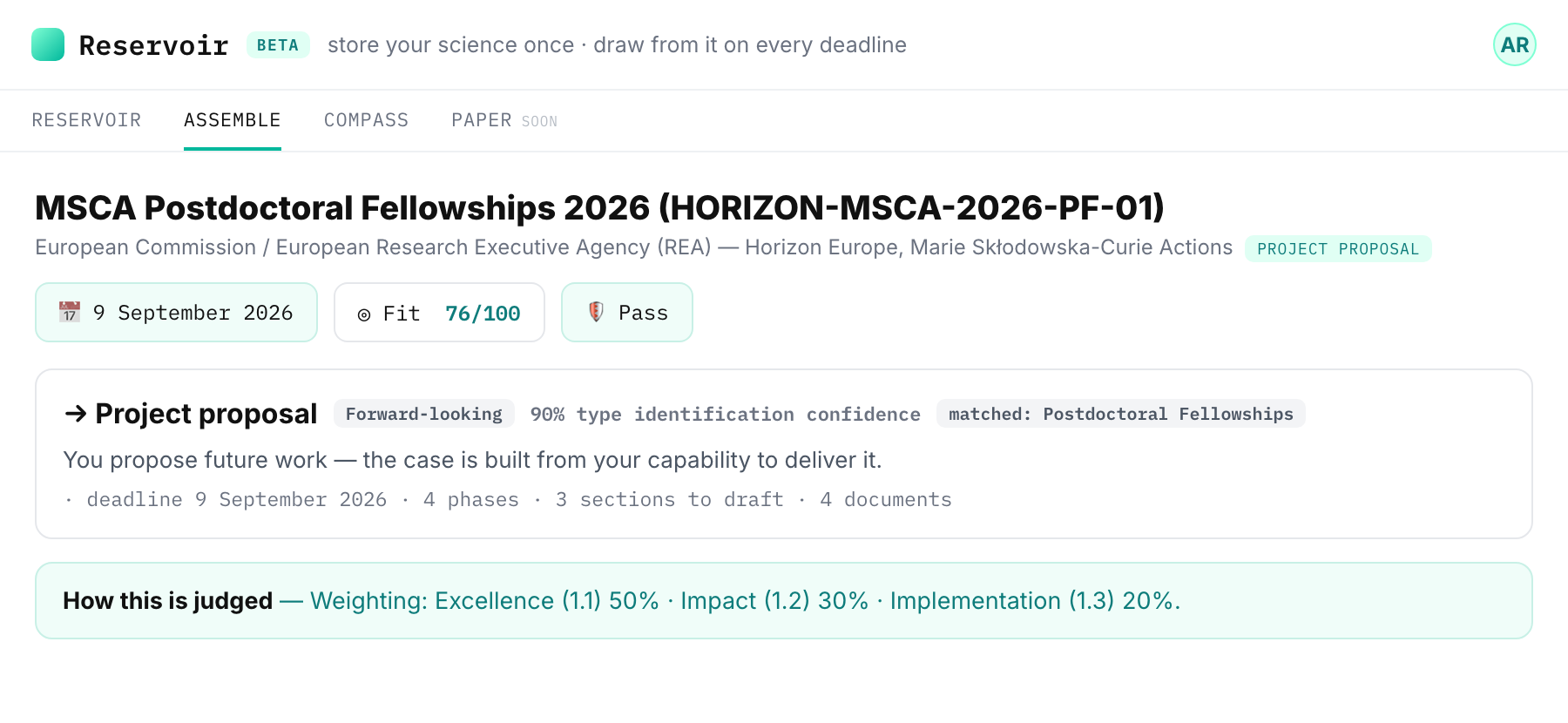
Click Open in Assemble. Reservoir fetches the official EU Funding & Tenders call page, reads it, and classifies it as a Forward-looking Project Proposal (90% type-identification confidence, matched: Postdoctoral Fellowships). It then maps your blocks to each required section and starts generating drafts. This runs in the background. Close the tab and come back to a built skeleton.
When it finishes you see the overall Fit (e.g. 76/100), a Pass status, the deadline, the four phases, and the exact source URL it parsed from. Parsing from the official call page, rather than an aggregator, gives the most faithful read of the requirements and required documents.
Step 4: Draft your Fellowship sections
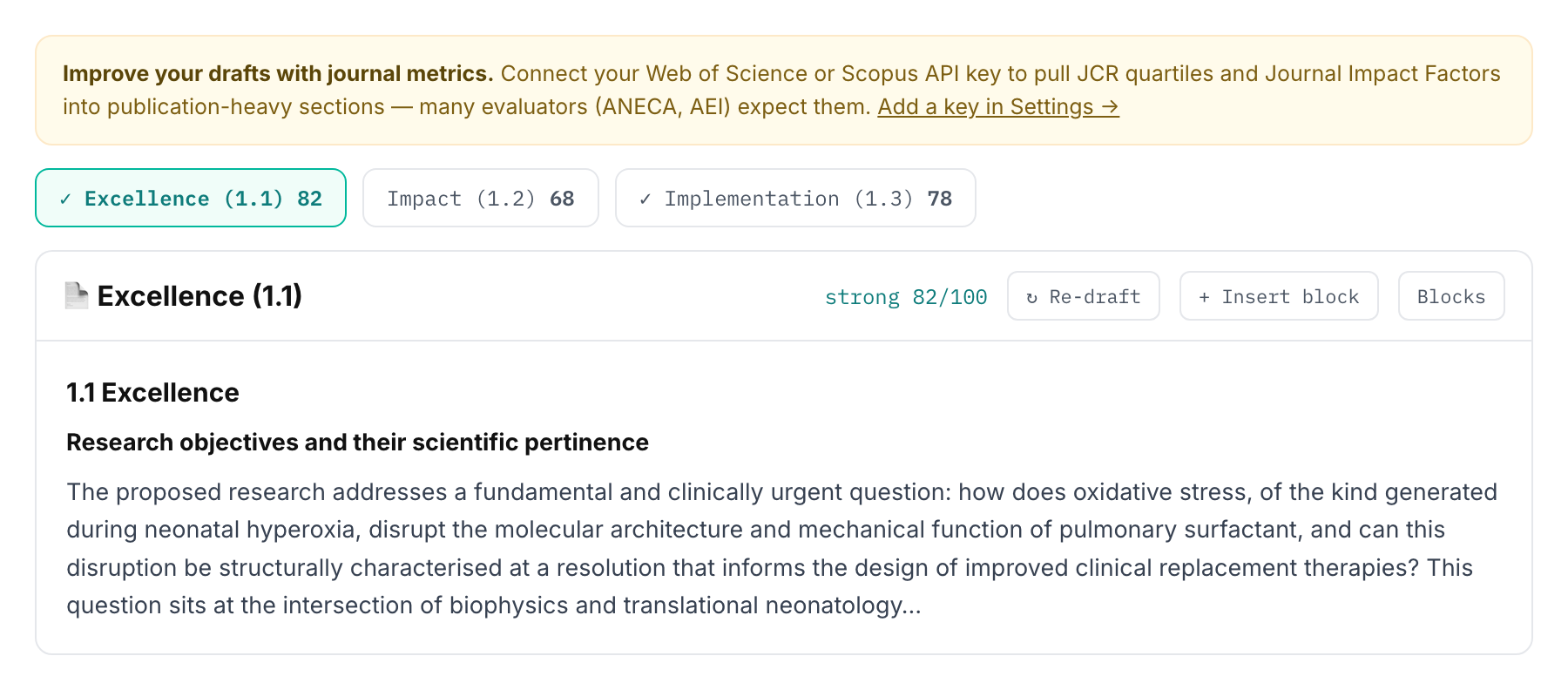
Part B1 has three sections, and they line up exactly with the evaluation criteria: Excellence (1.1), Impact (1.2) and Implementation (1.3), max 10 pages combined. Reservoir drafts a scaffold for each, built around the dossier you saved in Step 1, so the science reads in your evidence, not generic filler.
Every edit autosaves and re-scores live. The section score (for example, Excellence at *strong 82/100*) reflects three things Reservoir can measure: density of evidence, specificity, and how many placeholders you have filled. Use Re-draft for a fast start, then refine each section in your own voice.
Tip: connect your Web of Science or Scopus API key in Settings to pull JCR quartiles and Journal Impact Factors straight into publication-heavy sections. Many ANECA/AEI evaluators expect them.
Step 5: Handle the paperwork (Part B2 CV + letters)
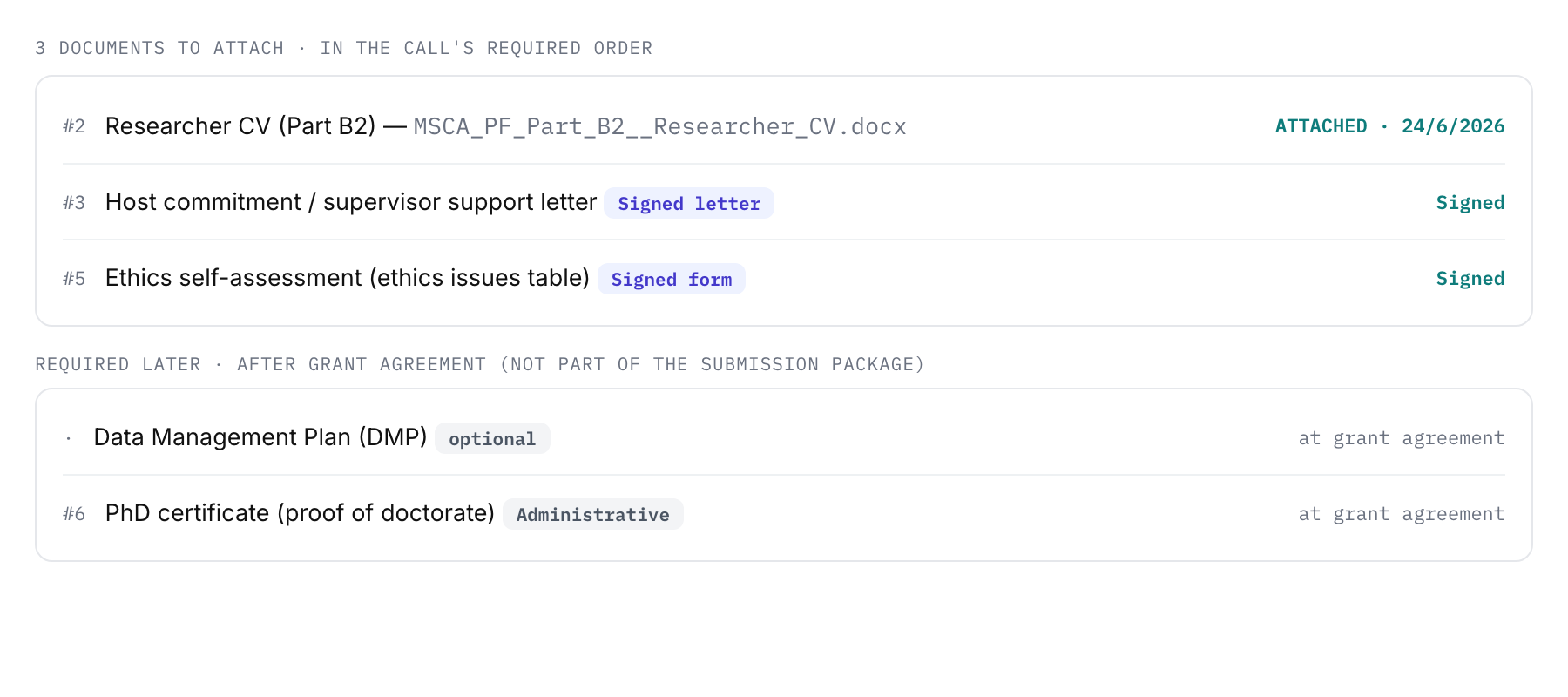
A great Part B1 still fails if the annexes are missing. Reservoir tracks the required documents in the order the call asks for them, and shows the status of each:
| # | Document | Status |
|---|---|---|
| 2 | Researcher CV (Part B2), auto-generated from your blocks | Attached |
| 3 | Host commitment / supervisor support letter, requested via the platform | Signed |
| 5 | Ethics self-assessment (ethics issues table) | Signed |
Reservoir also lists items required later, at grant agreement: the Data Management Plan (DMP) and the PhD certificate, so you do not confuse them with the submission package.
The mobility rule (watch this): you cannot have resided or carried out your main activity in the host country for more than 12 months in the 36 immediately before the deadline. Reservoir flags this automatically from your Positions blocks, so you find out now, not at submission.
Step 6: Assemble and export
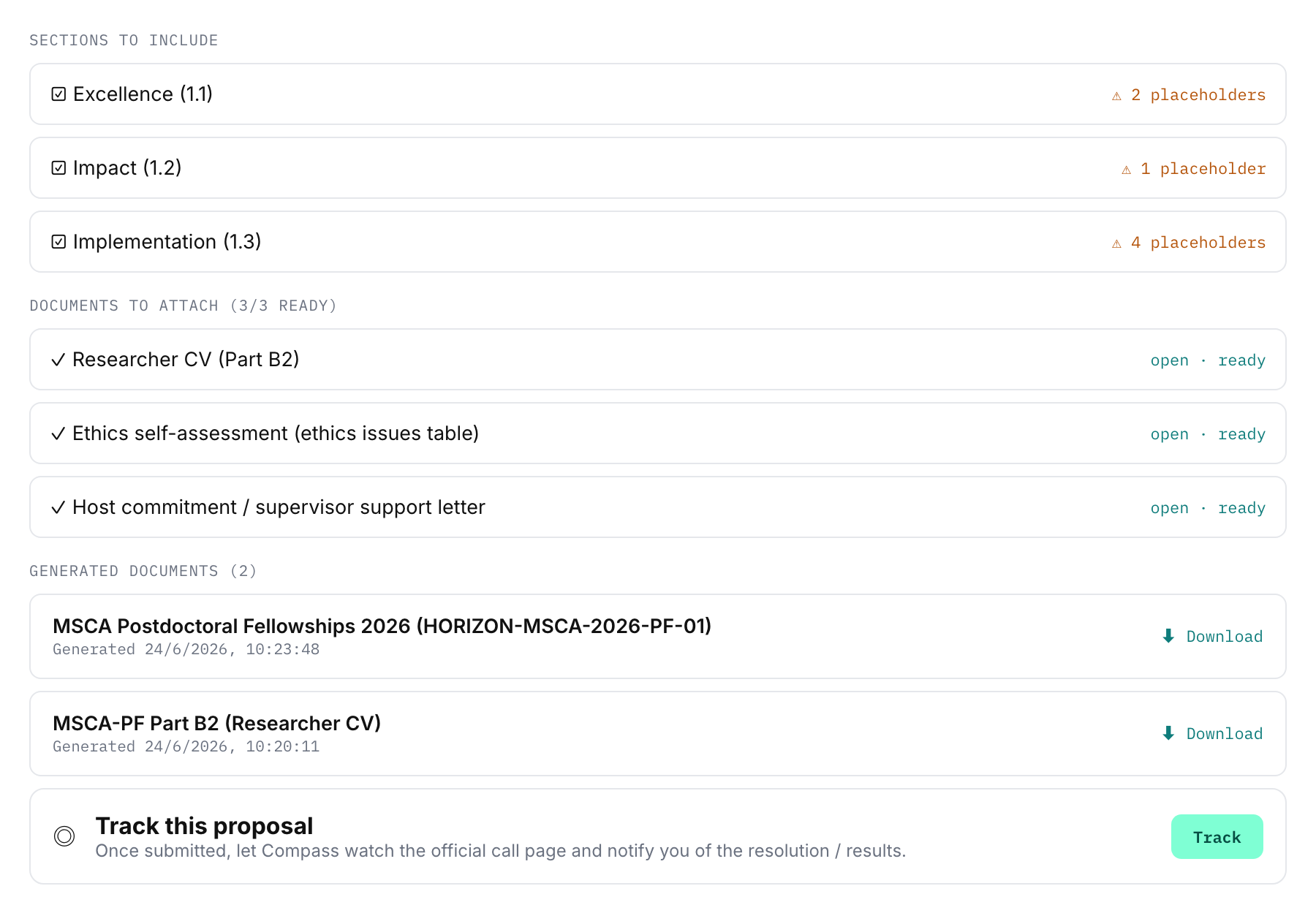
With every section drafted and the placeholders filled, go to Assemble & Export. Review the checklist: 3 sections selected, documents 3/3 READY. Download the full DOCX package ready to upload to the EU Funding & Tenders (SEDIA) portal, and grab the Part B2 CV separately. Then click Track this proposal so Compass watches the official resolution page and notifies you of the result.
Step 7: Ask Proposal Help when you are stuck
At any point, open Proposal Help in the sidebar. It is an AI advisor that knows both your blocks and the call document. Ask it “What should I write in section 1.1 about my research approach?” or “Does my mobility history qualify?” It answers from your actual data and the parsed call, and it does not invent anything or change your work.
Start early, revise often
The MSCA PF is decided in the coherence between your project and the researcher who will deliver it. The applicants who succeed are not the ones who write the most in the final week: they are the ones who start early and revise often. Reservoir keeps your score live as you edit, so every session moves the number. With the deadline on 9 September 2026, the time to build your career store is now.