The IUNE Observatory, which measures the research activity of Spanish universities every year, published its 2026 report on 8 July. The figures confirm a divergence that has been building for years and directly affects anyone building a research career in Spain.
The figures
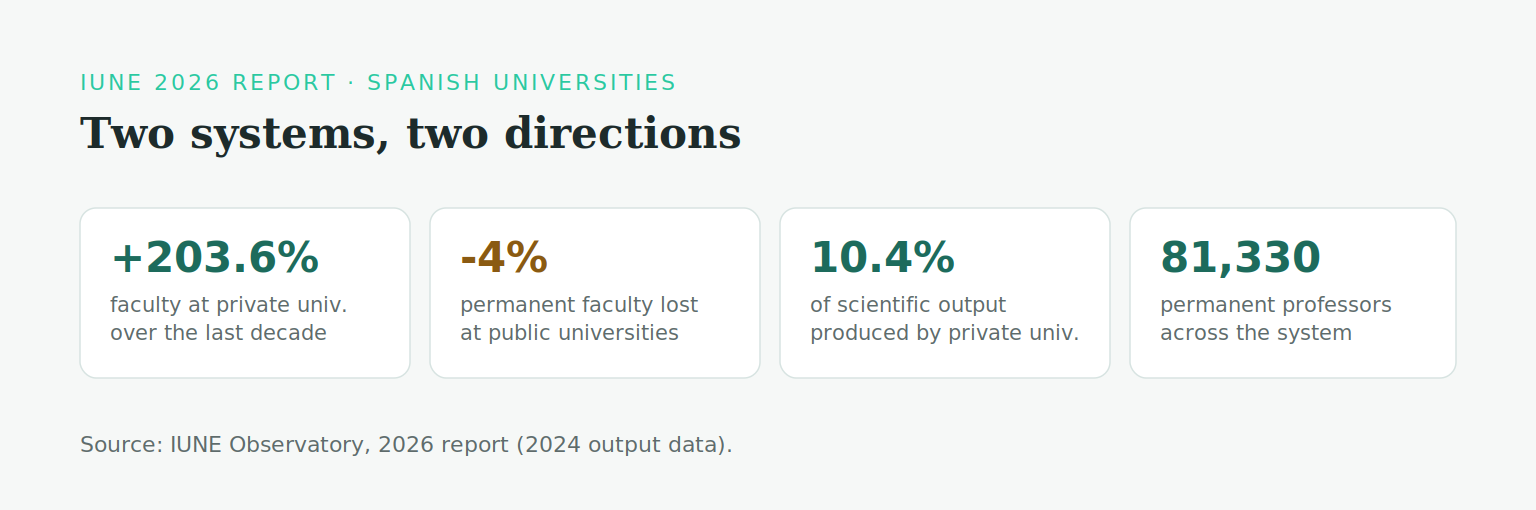
The Spanish University System has 81,330 permanent professors. The striking datum is how their evolution splits: over the last decade, private universities have tripled their faculty, growing by 203.6%, while public universities have lost 4% of their permanent teaching staff. The report describes it as a "massive expansion of faculty" at private institutions.
Scientific output, however, still lives in the public system. Private universities generate roughly 10.4% of the system's output (2024 data), although with notable regional exceptions: in Navarre, private research accounts for 68% of the region's total, and in La Rioja, 40.5%.
In productivity per professor, the report highlights Universitat Pompeu Fabra among public universities, with 6.14 articles per faculty member in 2024.
What it means for researchers
The simple reading would be "public universities research, private ones teach". The reality researchers live is less comfortable: the public system concentrates research but is losing permanent positions, which narrows the stabilisation funnel exactly where most output is produced. And private universities are hiring at a historic pace, but with profiles and workloads where research does not always have room, as their share of total output reflects.
For a predoc or postdoc, this translates into a two-speed job map: more teaching positions in the private sector and more competition for fewer stable positions in the public one, where the classic research career (sexenios, accreditations, projects) is still played out. The IUNE data put numbers to something the calls already reflect: pressure on every public research-profile position keeps growing.
The system, moreover, evaluates everyone with the same scientific-output yardstick, wherever they work. Those who build their career at a private university, with high teaching loads, later compete for accreditations and contracts against profiles trained in environments with more room to do research. It is a structural imbalance the report makes quantifiable.
To find your bearings
If you are weighing where to develop your career, the IUNE data are a good starting point for understanding what each environment offers. And if your goal is a research career, our funding-calls section has guides to the main Spanish public schemes (Ramón y Cajal, Juan de la Cierva, ISCIII programmes) with verified requirements, amounts and deadlines.
Sources
- IUNE 2026 report, IUNE Observatory (research activity of Spanish universities): iune.es
- Report coverage: Infobae/EFE, 8 July 2026: infobae.com