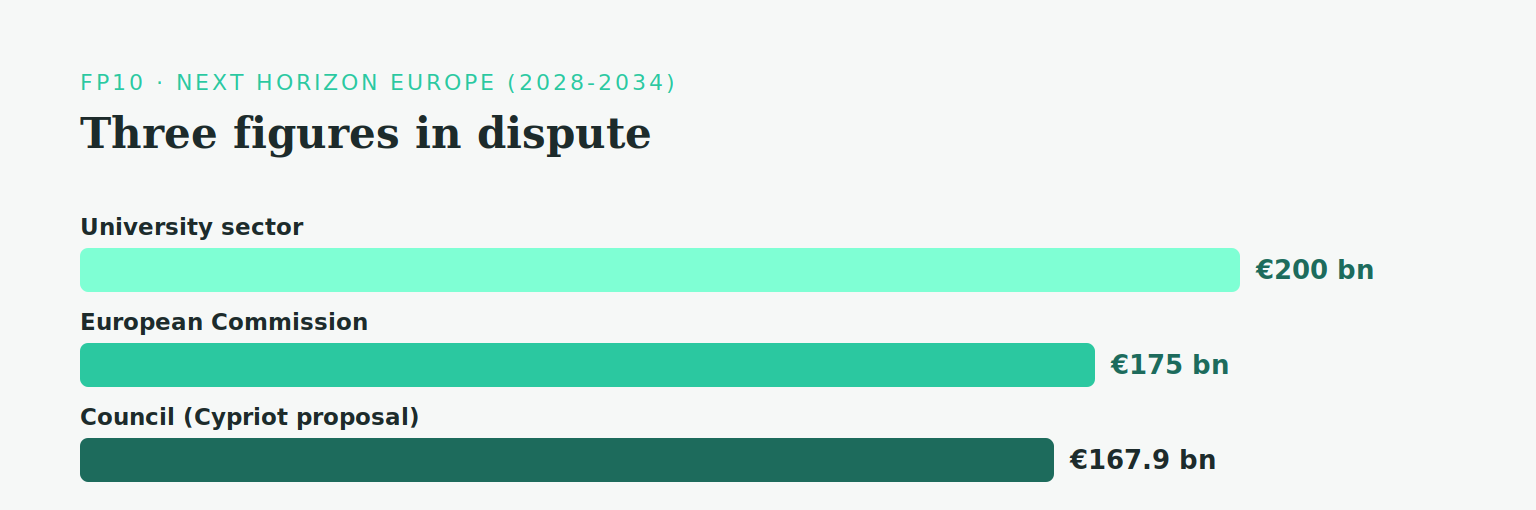
In July 2025, the European Commission proposed 175 billion euros for the successor to Horizon Europe (the FP10 programme, which will keep the Horizon Europe name and cover 2028-2034), up from 93.5 billion in the current programme. The research community breathed out: the programme would continue to exist as a standalone instrument, with more money. A year later, the real negotiation has begun, and it has begun downwards.
What is happening
The Cypriot presidency of the EU Council has tabled a proposal that reduces the FP10 budget from 175 to 167.9 billion euros, a cut of around 4%, twice the average cut applied to the overall multiannual budget. Erasmus+ would also fall (from 40.8 to 39.1 billion). All of this after European university groups had spent months arguing that the necessary figure was not 175 billion but 200 billion, in line with the Draghi report's recommendation.
The sector's reactions have been unusually blunt. The League of European Research Universities (LERU) called it "an astonishing act of political incoherence": proclaiming competitiveness as the top priority while cutting precisely the programme that generates it. The European University Association warned that any figure below the Commission's proposal is deeply concerning in a context where many countries are simultaneously freezing or cutting national R&D investment. And The Guild pointed at the incongruity of applying twice the average cut to research when the overall budget reduction is 1.9%.
Why it matters to working researchers
The part that matters most to an individual researcher is which programmes would absorb the blow. The EUA said it explicitly: a budget below the Commission's proposal risks further limiting support for the most competitive and oversubscribed parts of the programme, citing collaborative research, the ERC and the MSCA. In other words, the individual calls on which thousands of European postdocs' careers depend, which already today leave most excellence-rated proposals unfunded.
The timeline does not help certainty either. The Council reached a partial agreement on the programme's structure in late June (with the figures in brackets, pending the global budget negotiation), the European Parliament expects to adopt its position in September, and trilogues follow. Brussels hopes to close the multiannual budget by the end of 2026, though diplomats themselves admit the date is more an aspiration than a plan.
What to watch
For anyone planning a research career in Europe, three things: the final FP10 figure (between the Council's 167.9 billion and the sector's 200 billion there is a one-third difference); the internal split between pillars, which will decide how much reaches the ERC and MSCA; and the calendar, because a delayed agreement would prolong uncertainty over post-2027 calls. The current MSCA-PF 2026 call is not affected: it is funded under the existing programme.
Sources
- Cypriot presidency's proposed cut and reactions (LERU, EUA, The Guild, Cesaer): Times Higher Education, June 2026: timeshighereducation.com
- Council partial agreement on FP10 and bracketed figures: Science|Business, June 2026: sciencebusiness.net
- Original Commission proposal (€175 billion, four-pillar structure): Science|Business: sciencebusiness.net