If you landed here wondering whether you can use ChatGPT, Claude or any other generative AI to prepare your EU grant application, the short answer is yes: it is not forbidden. The full answer is that the permission comes with written obligations, that ignoring them can put your proposal out of the race, and that the framework was updated on 8 May 2026.
Here is what the three documents that affect you actually say, without interpretation: the Horizon Europe standard application form, the European Commission's ERA Living Guidelines in their May 2026 revision, and, if you are also evaluated in Spain, ANECA's criteria.
What the Horizon Europe application form requires
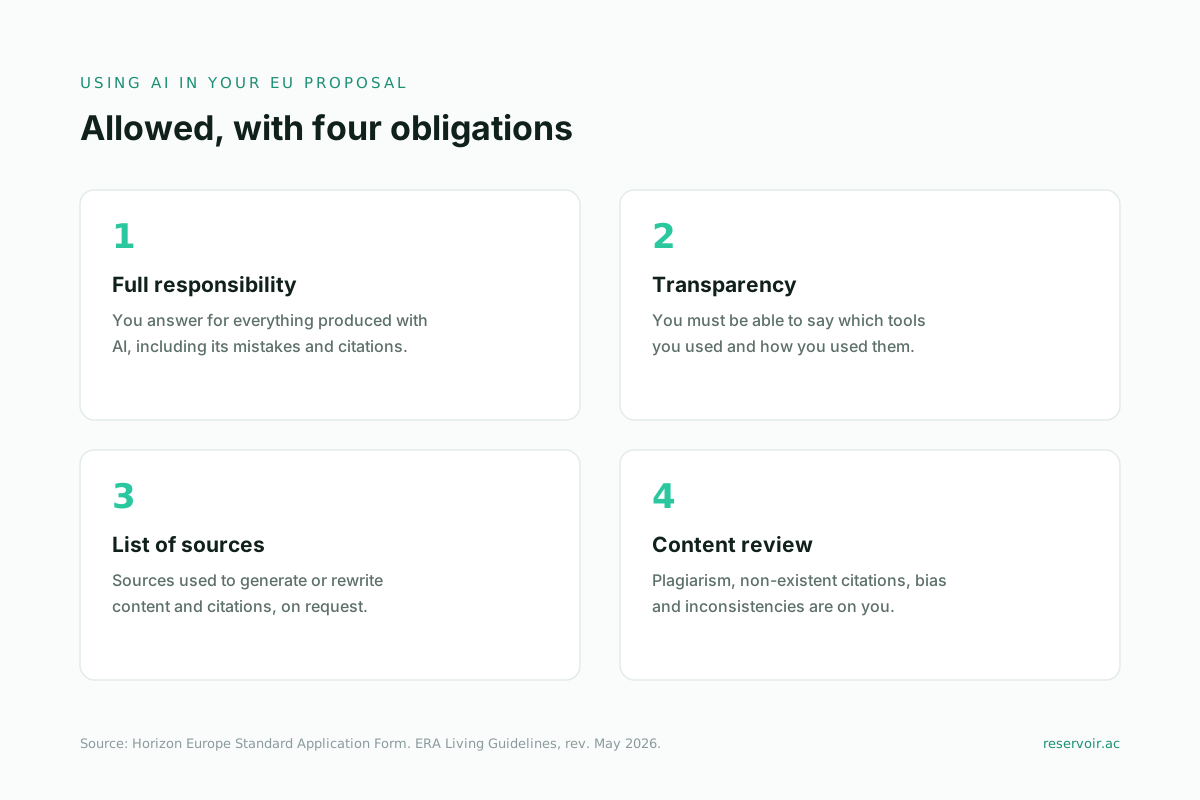
The Horizon Europe standard application form explicitly permits the use of generative AI tools when preparing a proposal. In exchange it sets four obligations, stated in the form itself (page 32, as the Dutch NCP guide by RVO points out):
- You are fully responsible for every part produced with an AI tool, including its mistakes.
- You must be transparent about which tools you used and how.
- You must be able to provide a list of the sources used to generate or rewrite content and citations.
- You must review the output: plagiarism, non-existent citations, bias and inconsistencies are on you.
The same text clarifies that using AI should not be considered cause for penalising a proposal. But the flip side is serious: RVO warns that failing to comply with the programme's AI guidelines can render a proposal ineligible.
The distinction matters: nobody penalises you for using AI. You can be left out for using it without transparency, without sources and without control.
The ERA Living Guidelines, updated in May 2026
The ERA Living Guidelines on the responsible use of generative AI in research are the integrity framework behind the form. First launched in 2024, they received their second revision from the Commission on 8 May 2026. The principles that matter to applicants:
- Accountability: researchers remain responsible for all outputs, AI-assisted or not. An AI tool cannot be an author or co-author.
- Transparency: disclose the use of generative AI whenever it substantially shapes the content.
- Sensitive activities: refrain from substantial generative AI use in peer review and in the evaluation of other people's proposals.
- Privacy and confidentiality: be careful about feeding personal data, unpublished ideas or third-party material into tools you do not control.
- Continuous learning: knowing the limitations of the tools is part of using them well.
The 2026 revision also adds new recommendations on third parties using AI during meetings, on AI-supported information management, and on so-called hidden prompts, instructions embedded in AI systems that can shape their outputs without the user seeing them.
In Spain, ANECA already asks for it in writing
This is not only a Brussels story. In ANECA's research-activity evaluation criteria for accreditation (aligned with CNEAI's sexenios criteria and applicable to applications submitted since 1 April 2024), the use of generative Artificial Intelligence must be declared whenever it affects the original content of the contribution. Personal contribution, in turn, is detailed using the CRediT taxonomy.
Every evaluation system is moving in the same direction: AI-use disclosure is becoming the standard. Building that habit now means not having to improvise it when it is mandatory everywhere.
The context: a flood of applications
Why did the rules tighten? Because AI has made application text cheap to produce. According to figures cited by sector platforms, Horizon Europe applications grew by around 80% compared with 2024. Science|Business reported in 2025 that the growing use of generative AI could be behind the rise in applications in certain calls, with success rates dropping to as low as 2% in some cases.
On the other side of the table, the Commission's guidelines ask evaluators to refrain from substantial generative AI use when assessing proposals. The ERC said in 2024 that it would not police applicants' AI use, and its president noted that personal interviews would gain weight: you have to be able to explain your own work. In the United States, the NIH went further and banned generative AI for drafting peer-review critiques.
The practical consequence: polished text no longer sets anyone apart, it is the new baseline. What differentiates a proposal is the verifiable substance underneath, and your ability to defend it in an interview.
What this means for you (opinion)
The question is no longer whether you can use AI in your application. It is whether you can answer for every sentence the AI helped you write. That is the real standard set by the form, the guidelines and ANECA. In practice:
- Keep a record of which tools you use and for which part of the proposal.
- Verify every citation and every claim against its original source. Invented citations are the most common failure and the most expensive one.
- Keep the list of sources used to generate or rewrite content: the form can require it.
- Disclose the use wherever the form or the call asks for it. It is not a confession, it is a requirement.
- Never paste confidential data, unpublished third-party ideas or personal data into tools you do not control.
My personal reading, and the thesis Reservoir is built on: the AI that actually helps your application is not the one that drafts from nothing, it is the one that proposes from your real record and lets you confirm before anything ships. Which is exactly the behaviour Brussels is turning into the norm.